
12-Hour Shift Schedule Templates for 24/7 Coverage
Updated · 8 min read
A 12 hour shift schedule covers a 24/7 operation with four crews, labeled A, B, C and D, each working 12-hour day or night jobs, so one crew is on days, one is on nights and two are off at any moment. Every four-crew rotation averages 42 hours per person per week (168 hours of weekly coverage divided by four crews). The common templates differ only in how they arrange those hours: the Panama (2-2-3) schedule never runs more than three days in a row, the DuPont schedule builds in a seven-day break every four weeks, and 4-on-4-off is the easiest to remember.
Below: copy-ready grids, a comparison, the overtime math, and how an agency keeps a 24/7 rotation filled for a plant, hospital unit or security post.
Key takeaways
- Any four-crew 12-hour rotation averages 42 hours a week, so some weeks always pass 40 and carry federal overtime; daily-overtime states and hospital 8-and-80 plans add more.
- Panama keeps every run to three days or fewer; DuPont trades a hard mid-cycle stretch for a full week off.
- A rotation stays filled when each crew has dedicated Crew Members, a trained float list and a confirmation the day before.
How does a 12-hour rotating shift schedule work?
A 12 hour rotating shift schedule splits each day into two 12-hour jobs and spreads them across four crews so the site is never uncovered. Two crews cover days and two cover nights, alternating within each pair. Rotating versions swap day and night crews periodically to share the nights; fixed versions do not.
A 24/7 post needs 168 hours of coverage a week; four crews share it, so each person averages 42. That is why every 24 hour coverage shift schedule below lands on 42, and why planning shift coverage starts with four people per position, plus cover for call-outs.
What is the Panama (2-2-3) shift schedule?
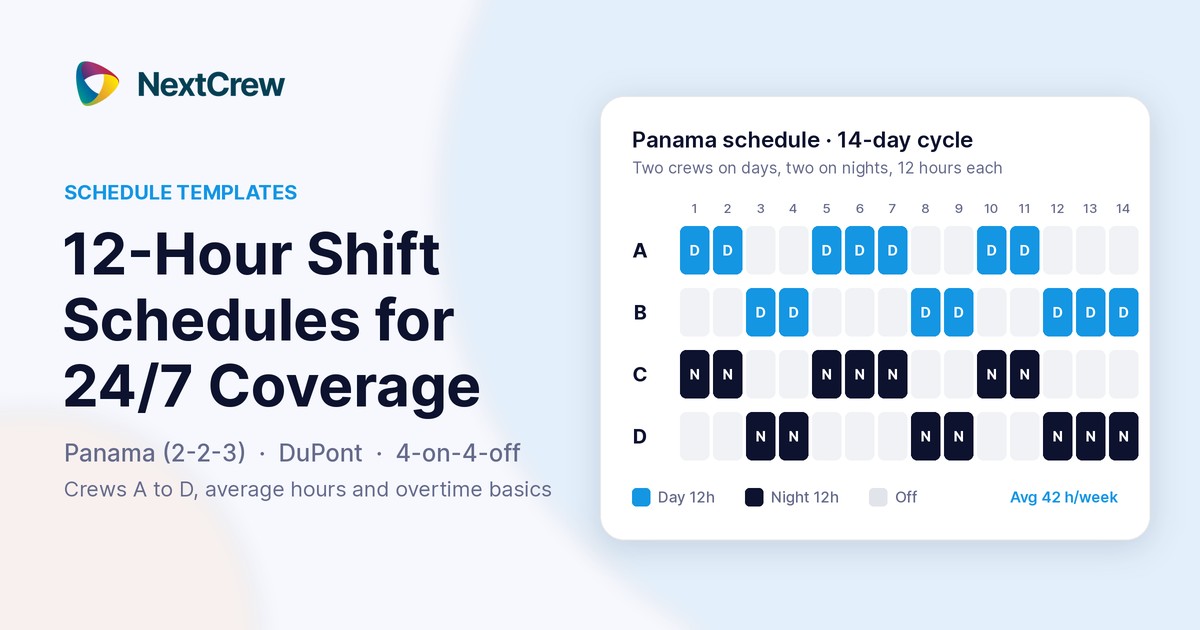
The Panama shift schedule is a 14-day 2-2-3 cycle: two days on, two off, three on, two off, two on, three off. Crews A and B cover days on opposite halves of the cycle, and crews C and D do the same on nights. In the rotating version below, they swap days and nights at day 15. The fixed version is often called the Pitman schedule, though the names are used loosely, so confirm which one a client means.
| Day | 1 | 2 | 3 | 4 | 5 | 6 | 7 | 8 | 9 | 10 | 11 | 12 | 13 | 14 | 15 | 16 | 17 | 18 | 19 | 20 | 21 | 22 | 23 | 24 | 25 | 26 | 27 | 28 |
|---|---|---|---|---|---|---|---|---|---|---|---|---|---|---|---|---|---|---|---|---|---|---|---|---|---|---|---|---|
| Crew A | D | D | – | – | D | D | D | – | – | D | D | – | – | – | N | N | – | – | N | N | N | – | – | N | N | – | – | – |
| Crew B | – | – | D | D | – | – | – | D | D | – | – | D | D | D | – | – | N | N | – | – | – | N | N | – | – | N | N | N |
| Crew C | N | N | – | – | N | N | N | – | – | N | N | – | – | – | D | D | – | – | D | D | D | – | – | D | D | – | – | – |
| Crew D | – | – | N | N | – | – | – | N | N | – | – | N | N | N | – | – | D | D | – | – | – | D | D | – | – | D | D | D |
D = 12-hour day job (for example 7 a.m. to 7 p.m.) · N = 12-hour night job (7 p.m. to 7 a.m.) · – = off. Each column has exactly one D and one N, so the site is covered around the clock.
Each crew works 84 hours every 14 days (42 a week). No run exceeds three days, and with a Monday start every other weekend is a three-day weekend.
What is the DuPont schedule?
The DuPont schedule is a 28-day rotation in which each crew works four nights, has three days off, works three days, has one day off, works three nights, has three days off, works four days, and then has seven days off. The four crews start the same sequence one week apart.
| Day | 1 | 2 | 3 | 4 | 5 | 6 | 7 | 8 | 9 | 10 | 11 | 12 | 13 | 14 | 15 | 16 | 17 | 18 | 19 | 20 | 21 | 22 | 23 | 24 | 25 | 26 | 27 | 28 |
|---|---|---|---|---|---|---|---|---|---|---|---|---|---|---|---|---|---|---|---|---|---|---|---|---|---|---|---|---|
| Crew A | N | N | N | N | – | – | – | D | D | D | – | N | N | N | – | – | – | D | D | D | D | – | – | – | – | – | – | – |
| Crew B | – | – | – | – | – | – | – | N | N | N | N | – | – | – | D | D | D | – | N | N | N | – | – | – | D | D | D | D |
| Crew C | – | – | – | D | D | D | D | – | – | – | – | – | – | – | N | N | N | N | – | – | – | D | D | D | – | N | N | N |
| Crew D | D | D | D | – | N | N | N | – | – | – | D | D | D | D | – | – | – | – | – | – | – | N | N | N | N | – | – | – |
D = day · N = night · – = off.
Each crew works 168 hours per cycle (42 a week). The seven-day break is the draw; the cost is six jobs in seven days mid-cycle, with one day off between day and night jobs.
What is a 4 on 4 off schedule?
A 4 on 4 off schedule has each crew work four 12-hour jobs, then take four days off. The rotating version below alternates four days and four nights over 16 days.
| Day | 1 | 2 | 3 | 4 | 5 | 6 | 7 | 8 | 9 | 10 | 11 | 12 | 13 | 14 | 15 | 16 |
|---|---|---|---|---|---|---|---|---|---|---|---|---|---|---|---|---|
| Crew A | D | D | D | D | – | – | – | – | N | N | N | N | – | – | – | – |
| Crew B | – | – | – | – | D | D | D | D | – | – | – | – | N | N | N | N |
| Crew C | N | N | N | N | – | – | – | – | D | D | D | D | – | – | – | – |
| Crew D | – | – | – | – | N | N | N | N | – | – | – | – | D | D | D | D |
D = day · N = night · – = off.
Each crew works 96 hours every 16 days (42 a week). Days off drift through the week, so weekends off are irregular.
Which 12-hour schedule should you choose?
Choose the pattern by what the client and the Crew value most: short runs, long breaks or simplicity. Coverage and average hours are identical.
| Pattern | Cycle | Longest run on | Longest break | Pros | Cons |
|---|---|---|---|---|---|
| Panama (2-2-3) | 14 days, 28 if rotating | 3 days | 3 days | Short runs, every other weekend off | Many day/night changes in the rotating version |
| Pitman (fixed 2-2-3) | 14 days | 3 days | 3 days | Same rhythm with no day/night switching | Night crews stay on nights indefinitely |
| DuPont | 28 days | 4 days (6 jobs in 7 days) | 7 days | A full week off every cycle | Hard mid-cycle stretch; one-day turnaround from days to nights |
| 4-on-4-off | 8 days, 16 if rotating | 4 days | 4 days | Simplest to remember and staff | Days off drift; four nights in a row |
Do 12-hour shifts get overtime?
Under federal law, a 12-hour job does not trigger overtime by itself; the Fair Labor Standards Act requires time and one-half for hours over 40 in a workweek. The US Department of Labor says the workweek is a fixed, recurring 168-hour period and averaging hours over two or more weeks is not permitted (Fact Sheet #23, revised October 2019). So a rotation averaging 42 always has weeks over 40.
How much over depends on where the workweek starts. It may start on any day and hour, but a change must be permanent and not designed to avoid overtime (29 CFR 778.105).
| Illustrative example: Crew A | Weekly hours | Average overtime per week |
|---|---|---|
| Panama, workweek starts on day 1 of the cycle | 60, then 24 | 10 hours |
| Panama, workweek starts on day 2 | 48, then 36 | 4 hours |
| DuPont, workweek starts on day 1 | 48, 72, 48, 0 | 12 hours |
| DuPont, workweek starts on day 4 | 48, 36, 48, 36 | 4 hours |
| 4-on-4-off (any start) | Mix of 48 and 36 | 4 hours |
To run your own rotation, pay rate, night differential and state rule, including California and 8-and-80, use the 12-hour shift overtime calculator. It shows every crew's weekly hours and the yearly overtime cost for each possible workweek start.
Illustrative example: our arithmetic from the grids, counting each job in the week it starts. Two rules raise overtime further:
- State daily overtime. California requires time and one-half after 8 hours in a workday and double time after 12 (California Department of Industrial Relations), unless a valid alternative workweek schedule applies. Some other states have daily rules too.
- The hospital 8-and-80 system. Hospitals and residential care establishments may agree in advance to a 14-day period with overtime after 8 hours a day and 80 in the period (29 CFR 778.601). Both rules make 4 hours of every 12-hour job overtime.
For an agency, the bill rate must carry the expected overtime and any night shift differential, or margin disappears on the 48-hour weeks. This is general information, not legal advice.
What about fatigue and safety on 12-hour rotations?
Long jobs plus long weeks carry real fatigue risk. A NIOSH review of research on overtime and extended work shifts (Caruso and colleagues, DHHS (NIOSH) Publication No. 2004-143, April 2004) found six studies of 12-hour shifts combined with more than 40 hours a week reporting more health complaints, poorer performance and a slower work pace.
- Avoid stacking pickups onto a rotation; each one pushes a 48-hour week higher.
- Give at least a full day off when a crew switches from nights to days.
- Plan breaks inside each 12-hour job and watch long drives home after nights.
How does a staffing agency staff a 12-hour rotation?
An agency staffs a rotation by treating each crew as a standing team, not a string of one-off jobs.
-
1
Assign dedicated Crew Members to each crew
The same people every cycle learn the site and the supervisor.
-
2
Build a float list per site
Keep trained, site-approved Crew Members on call so a same-day backfill is someone who knows the floor.
-
3
Confirm the day before
Message tomorrow's Crew and chase non-confirmers while there is time to find cover.
-
4
Watch the handover
Gaps show up at changeover. Some clients add an overlapping swing shift.
-
5
Track hours against the workweek
Know who is heading for 48 hours before payroll does.
Night call-outs are the usual failure point; see how to prevent and track no-shows.
How does NextCrew fit?
NextCrew lets an agency set a rotation up once and run it, instead of rebuilding it every cycle. Jobs can be cloned or set recurring, so each crew's pattern repeats. Inside a job, a job schedule sets the exact days and hours each Crew Member works, so one person can hold a two-week job and be scheduled only on their two-, two- and three-day stretches, with different hours on different days if needed. On their days off, NextCrew shows them as available, so you can book them on other work instead of losing them for the whole cycle. A scheduled message can confirm tomorrow's Crew, with replies landing on each Crew Member's record. Pay and bill rates, including differentials and overtime, are set by client, position and job, and approved timesheets flow to invoicing and payroll without re-entry. See scheduling and job management or industrial staffing.
Frequently asked questions
Sources
- US Department of Labor, Wage and Hour Division, "Fact Sheet #23: Overtime Pay Requirements of the FLSA," revised October 2019.
- Office of the Federal Register and US Government Publishing Office, eCFR, 29 CFR 778.105, "Determining the workweek," and 29 CFR 778.601 (section 7(j) overtime for hospitals and residential care establishments), accessed October 8, 2026.
- California Department of Industrial Relations, Labor Commissioner's Office, "Overtime" FAQ, accessed October 8, 2026.
- Caruso CC, Dick RB, Hitchcock EM, Russo JM, Schmit JM, "Overtime and Extended Work Shifts: Recent Findings on Illnesses, Injuries, and Health Behaviors," DHHS (NIOSH) Publication No. 2004-143, April 2004.