
No Call No Show Policy for Staffing Agencies: Template and Rules
Updated · 12 min read
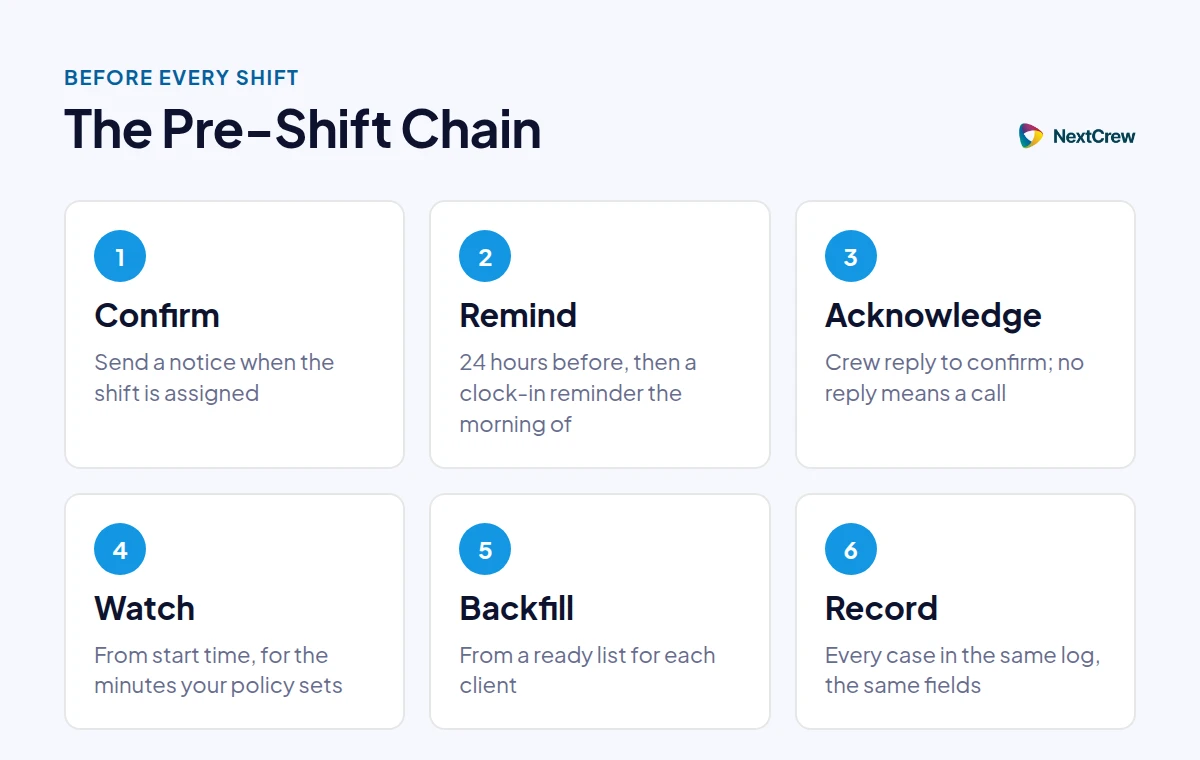
A no call no show policy is the written rule that tells your Crew how to call off a shift, what counts as a no-call no-show, what happens after one, and how every case is recorded. For a staffing agency it has seven parts: a definition with a set number of minutes, the call-off channel and deadline, what's excused, a check for false no-shows, a consequence ladder, one way to record each case, and a signature at onboarding. The policy only works alongside a reminder routine before every shift. This guide calls that routine the Pre-Shift Chain.
Skip to the no call no show policy template →
Key takeaways
Why does a no-call no-show hurt a staffing agency more than an employer?
When an employee skips a shift, the employer has a gap on its own schedule; when a Crew Member skips a shift, your agency has a gap on your client's floor, and the client usually sees it before you do. Their supervisor is the one standing at the empty station at start time, wondering where your person is.
The cost lands in three places at once: the shift goes unbilled, the coordinator's morning goes to finding a replacement who may cost more, and the client quietly rethinks how deep your bench is.
That last one is the expensive part. One no-show is a bad morning; a pattern of them, handled differently each time, is how a client decides to call a second agency. For prevention tactics, see how to prevent and track no-shows; this guide is about the rule itself.
How do most agencies handle no-shows today?
In most agencies the no-show policy exists, but nobody has written it down. It lives in the head of the coordinator who's been there longest: three strikes, probably, unless it's a good Crew Member, or a busy week, or the client didn't notice.
The routine around it looks something like this:
- The record, if there is one, is a note in a phone, a line in a spreadsheet, or a comment on a text thread.
None of this is careless. It's what happens when an agency grows faster than its paperwork, and for a small bench it mostly holds together.
Why doesn't an unwritten no-show rule work?
An unwritten rule breaks in the same five places at almost every agency. Here is each one, next to what a written rule changes.
| Where it breaks | Without a written rule | With one |
|---|---|---|
| Who decides | Each coordinator applies their own rule. Crew notice, and it feels unfair even when it isn't. | Every coordinator applies the same rule, from the same page. |
| Clock-in problems | A dead phone, no signal, a gate that isn't open yet: a reliable person gets a strike for a problem that wasn't theirs. | The site is checked first, and a confirmed arrival is never recorded as a no-show. |
| The client | Gets "we're on it." The second time, they want to know what happened and how often. | Gets a record: what happened, who you sent and how often it's happened on their account. |
| Repeat no-shows | Nobody can count them, so the same names keep getting booked. | Counted against your ladder, so they come off the bench. |
| Volume | The phone tree works for a handful of shifts, not when start times stack up across several clients. | The routine runs before the shift, so the morning starts with a short list of exceptions. |
What should a no call no show policy include?
A staffing agency's no call no show policy needs seven parts. Each one answers a question a coordinator would otherwise answer on the spot, differently every time.
-
1
The definition.
How many minutes after start, with no contact, counts as a no-call no-show.
-
2
How to call off.
Which channel counts, and how far ahead of the shift.
-
3
What's excused.
The list, and what proof, if any, you ask for.
-
4
The false no-show check.
Confirm with the site before anything is recorded, and check the geofenced time clock boundary.
-
5
The consequence ladder.
What happens after the first, second and third.
-
6
How every case is recorded.
One log, the same fields every time.
-
7
A signature at onboarding.
Crew sign it before their first shift.
The template below has each part written out, ready to fill in.
At start time, parts 1, 4 and 5 come down to two questions, asked in this order.
Is it really a no-call no-show?
The start time and your watch window have passed, and they haven't clocked in.
Question 1
Did they contact you before the window closed?
A call, a text or a message in the app.
Yes: late or a call-off
Apply your late and call-off rules, not the no-show rule.
Question 2
Are they on site but unable to clock in?
Ask the site supervisor before you record anything.
Yes: a false no-show
Clock them in and record nothing against them.
It's a no-call no-show
Backfill the shift, tell the client, record it the same way every time and apply the next step on your ladder.
The Pre-Shift Chain: the routine that keeps you from needing the policy
The policy is the backstop. The daily work happens before the shift starts. The Pre-Shift Chain is six links: confirm at assignment, remind 24 hours before and the morning of, ask Crew to acknowledge, watch from start time, backfill from a ready list, and record every case. Each link catches what the one before it missed, and the rollout steps below set up each one.
No call no show policy template
Copy this no call no show policy template into your own document, fill in the blanks, and have your employment counsel review it before you use it.
[Agency name] No-Call No-Show Policy
1. Who this covers. This policy applies to every Crew Member placed by [Agency name] on any client assignment.
2. What counts as a no-call no-show. You are a no-call no-show if you don't arrive for a scheduled shift and don't contact us within [__] minutes of the shift's start time.
3. How to call off. If you can't work a shift, tell us by [phone / text / the app] at least [__] hours before the start time. Telling the client or another Crew Member does not count as calling off.
4. Excused absences. These are excused when you tell us as soon as you reasonably can: [your list]. We may ask for [what proof, if any]. Anything else is reviewed by [role].
5. On site but can't clock in. Tell your coordinator right away by [channel]. We confirm with the site before anything is recorded, and a confirmed arrival is not a no-show.
6. What happens next. First no-call no-show: [__]. Second within [__] days: [__]. Third within [__] days: [__]. [Optional: [__] consecutive no-call no-shows are treated as a voluntary resignation.]
7. How it's recorded. Every no-call no-show is recorded with the date, client, shift and the reason you gave. You can ask to see your record at any time.
8. Acknowledgment. I have read and understand this policy.
Crew Member name: ____________ Signature: ____________ Date: ________
This template is a starting point, not legal advice. Employment rules vary by state, so review it with your employment counsel before you adopt it.
Want the editable Word version? It adds four reminder scripts (assignment notice, 24-hour reminder, morning clock-in reminder, late check-in), a one-line client notice, the tracking log and the cost worksheet.
Email me the editable version or write to info@nextcrew.com, and we'll send the Word file the same day.
How do you create and roll out a no call no show policy?
You create and roll out a no call no show policy in nine steps, and each one can be done this week, with or without software. Steps 3 to 9 are the Pre-Shift Chain in practice.
-
1
Write it from the template.
Fill in the blanks: your minutes, your call-off channel, your excused list, your ladder.
-
2
Add it to onboarding with a signature.
New Crew sign before their first shift. Send it to your current Crew too, and ask them to sign.
-
3
Send a notice at assignment.
Every shift, every time, with the address, start time and who to report to.
-
4
Send a 24-hour reminder, then check who has acknowledged.
Message anyone who hasn't confirmed the shift and ask for a reply. Call anyone who doesn't answer.
-
5
Send a clock-in reminder the morning of.
Short, and timed before they leave home.
-
6
Set a watch window.
Decide how many minutes after start before it counts, and who gets told when that window passes.
-
7
Check for a false no-show before anything else.
Is the Crew Member on site but unable to clock in? Ask the site before you record.
-
8
Keep a backfill list for each client.
Crew who know the site, the role and the client's rules, ready to call first.
-
9
Record every case the same way and review it weekly.
Use the log in the next section, and look at it on the same day each week.
How do you track and measure no-shows?
You track no-shows by logging every case the same way, then measure one number from that log each week.
Track every case in one log. Use the same columns every time, whoever is on shift:
- Date, client and shift
- Crew Member
- Minutes past start when it was called
- Whether they were reached, and the reason they gave
- False no-show: yes or no
- Whether the shift was backfilled, and how fast
Then mark the shift's timesheet as not worked, so the hours are neither billed nor paid. Never delete the entry; a no-show you can't see is one you can't count.
Measure one number weekly.
No-show rate = no-shows ÷ confirmed shifts × 100
Work it out for the whole agency, then by client and by Crew Member, and watch three things alongside it:
- False no-shows, counted on their own line. A rising count points to a clock-in problem at a site, not a Crew problem.
- Repeat no-shows, against your policy's own threshold. These are the names your ladder applies to.
- Acknowledgments, checked the day before. A shift nobody acknowledged is the one to call about first.
Compare before and after. Work out the rate for the four weeks before the rollout and the four weeks after, for the same clients. That's how you'll know it worked, in your own numbers.
What does one no-show cost your agency?
What one no-show costs depends on your rates, your clients and how fast you backfill, so the only useful figure is your own. The worksheet in the template walks through it line by line:
| Cost | How to work it out |
|---|---|
| Lost billable hours | Hours in the shift × your bill rate, for any hours not covered by a replacement |
| Coordinator time | Minutes spent calling and backfilling × the coordinator's hourly cost |
| Backfill premium | Any overtime, short-notice bonus or higher rate paid to the replacement |
| Client credits | Any credit or penalty in your agreement for an unfilled post |
| The client at risk | Hard to price, so don't guess. Write down what the account is worth to you in a year, and keep that number in view |
Add the first four for one no-show, then multiply by last month's count. That total is what fixing the process is worth.
What does this look like when it's automated?
Automated, the Pre-Shift Chain runs on its own and every no-show leaves the same record, without anyone remembering to do it. Everything above works with a spreadsheet and a phone; software matters once the volume grows.
In NextCrew, the notice at assignment, the 24-hour reminder and a clock-in reminder at the number of minutes before the start that you set go out automatically by email and app notification, and by text once the Twilio integration is turned on. Crew acknowledge the job in the app when they confirm it. Daily Pulse shows who is late or missing on today's timesheets at the thresholds you set, and the user assigned to the job gets an email 15 minutes after start. From that one screen a coordinator can message every no-show at once, clock in a Crew Member who texted that they're on site, and backfill from the job's Invite screen.
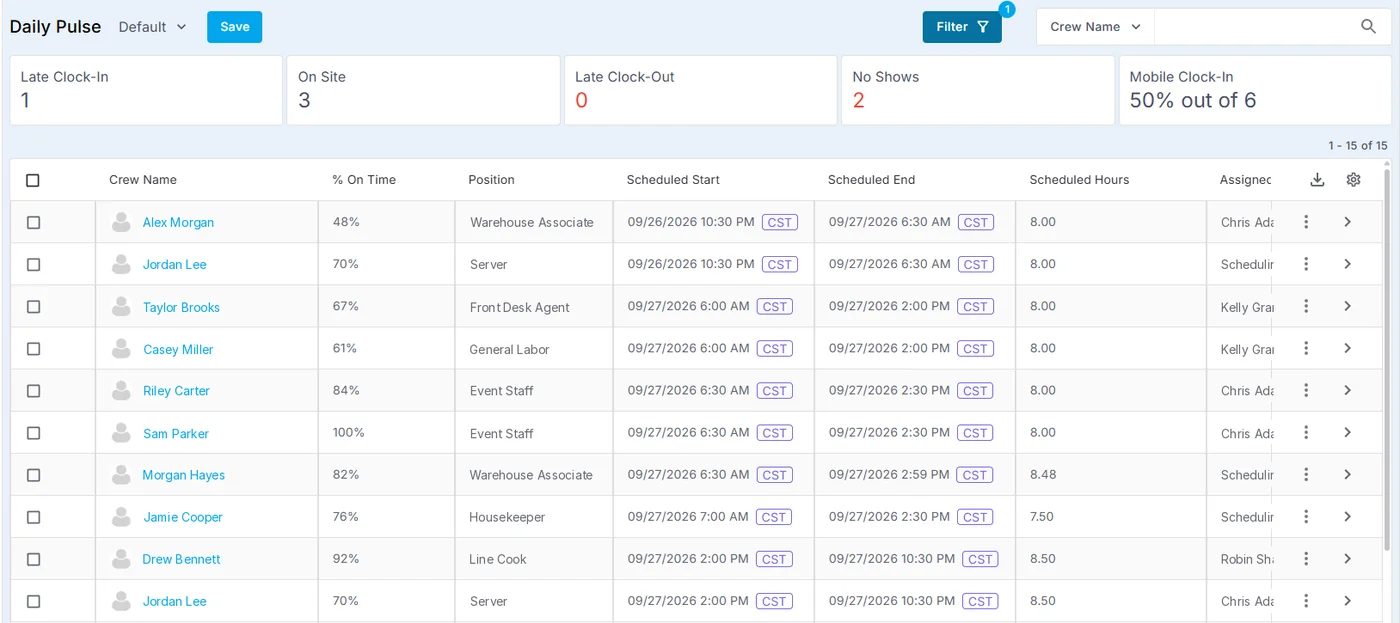
The record keeps itself consistent too. The timesheet is marked Not Completed, a violation is added to the Crew Member for that client, and it shows on the Crew Member's profile and in the No-Show Report, which lists every no-show across Crew and clients for your weekly review. The client can see live check-in status in their portal, so they aren't the first to find the empty station.
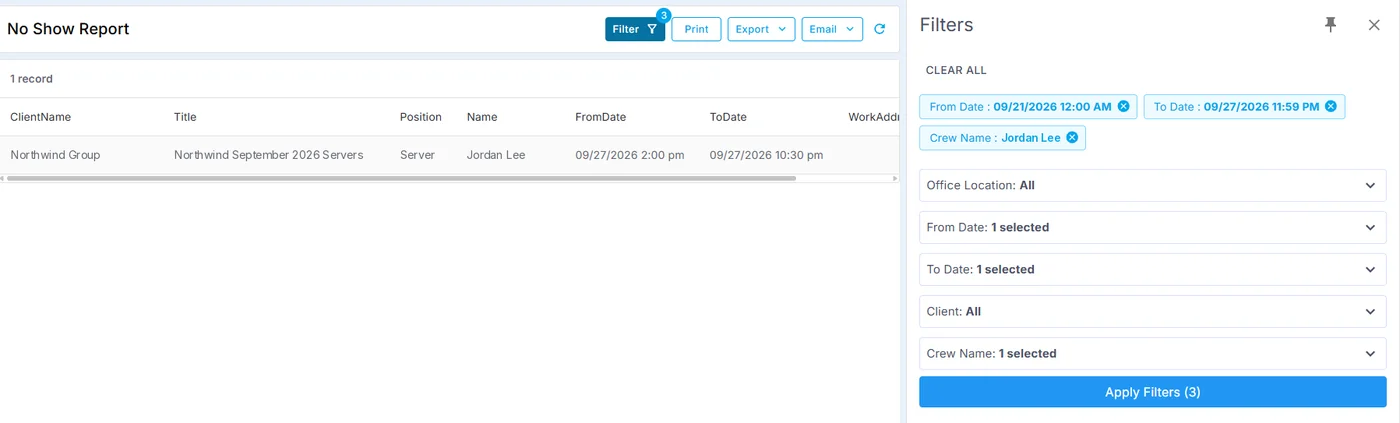
See how NextCrew handles no-shows, from the first reminder to the No-Show Report.