
How to Prevent Scheduling Staff With Expired Credentials
Updated · Compliance and credentialing
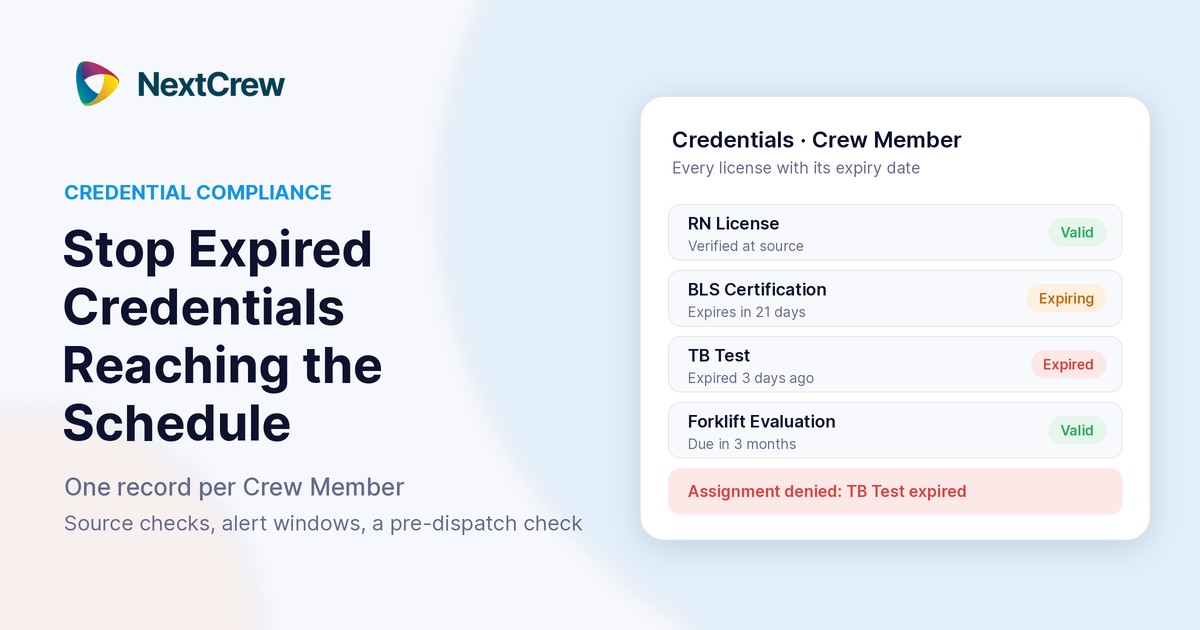
To prevent scheduling staff with expired credentials, keep one credential record per Crew Member with every expiry date, verify licenses at the primary source, set alert windows well ahead of each expiry, name one person who owns the check, and make "credential current for this job" a step the coordinator confirms before every assignment. A weekly review of what is expiring catches the rest before it reaches a client.
Most lapses are dates nobody was looking at. When licenses and certifications live in spreadsheets, inboxes and paper files, an expired credential surfaces only when a client or auditor finds it. This guide covers how to prevent scheduling staff with expired credentials: why credentials lapse, the process that stops it, and a checklist by vertical.
Key takeaways
- Lapses come from overlapping cycles. Each credential renews on its own schedule, so a single "compliance date" per person does not work.
- The control is a process step. The coordinator confirms the credential is current before confirming the assignment, every time.
- Verify at the source, not from a photocopy. For nurses, Nursys is the primary-source-equivalent check.
- Plan for a mid-assignment lapse before it happens. Decide in advance who tells the client and who covers the job.
Why do staff credentials lapse in the first place?
Credentials lapse because each one renews on its own cycle, and agencies track them in too many places to see all the dates at once. Four patterns cause most of it:
- Different renewal cycles. An American Heart Association BLS completion card is valid for two years (American Heart Association, BLS course options page, accessed October 2026). State licenses follow each board's own calendar. Facility health requirements follow the client's policy.
- Multi-state licenses. A nurse with a multistate license can practice in other Nurse Licensure Compact states, but a job in a non-compact state needs that state's license, with its own expiry. One nurse can carry several dates.
- Industrial certifications with event-based triggers. OSHA requires a performance evaluation of each powered industrial truck operator at least once every three years, and refresher training sooner after an accident, a near-miss, unsafe operation or a change of truck type (OSHA, 29 CFR 1910.178(l)(4)). That date can move without warning.
- Client-specific rules. CDC guidance says annual TB testing of health care personnel is not recommended without a known exposure or ongoing transmission (CDC, TB Screening and Testing of Health Care Personnel, last reviewed December 15, 2023, based on the 2019 MMWR recommendations). Many facilities still set their own requirements, so the rule that applies is often the client's contract, not the national guidance.
How do healthcare staffing agencies ensure credentialing and compliance?
Healthcare staffing agencies ensure credentialing and compliance by verifying every license with the issuing source, recording each expiry on the Crew Member's file, and re-checking before each assignment. A copy of a license card proves the card existed once. Primary source verification confirms with the issuing body that the license is active today, with no restrictions.
For nurses, the source is Nursys. The Nurse Licensure Compact's employer fact sheet states that "Nursys is primary source equivalent," that employers can verify a license with a QuickConfirm report at no cost, and that employers should enroll nurses in e-Notify to receive status change notifications (Nurse Licensure Compact, "What Nurse Employers Need to Know," 2025 employer fact sheet). For other credentials, verify with the certifying body or the client's required source. The full healthcare credentialing file covers more than licenses, but license expiration tracking is where most scheduling risk sits.
How do you prevent scheduling staff with expired credentials, step by step?
The answer is six habits that turn credential tracking from a filing task into a check that runs before every assignment.
-
1
Keep one credential record per Crew Member
Every license and certification sits on the Crew Member's profile with its number, issuing state or body, verification date and expiry date. No side spreadsheets: if three people each keep a list, none of them is right.
-
2
Verify at the source on intake and at renewal
Check the license with the board or Nursys, not a photo. Record who verified it and when. Re-verify when the Crew Member uploads a renewal.
-
3
Set alert windows, for example 60, 30 and 7 days
At 60 days, remind the Crew Member. At 30, follow up personally. At 7, escalate to the compliance owner and stop offering that person jobs that run past the expiry date. Fit the windows to how long renewals take.
-
4
Name one owner for the check
One person, usually the compliance manager, owns the credential file and the escalations. Coordinators own the pre-assignment check. Write both down.
-
5
Add a pre-dispatch check to the coordinator's process
Before confirming any assignment, the coordinator checks that every credential the job requires is current through the last day of the job, not just today. If anything is flagged, the assignment waits until compliance clears it. This step is your control; tools only make it fast.
-
6
Run a weekly expiring review
Once a week, the compliance owner reviews every credential expiring in the next 30 to 60 days, who has been contacted, and who is booked past their expiry. A short, regular review is far cheaper than an urgent call from a client.
What credentials should you track by vertical?
The checklist depends on the vertical and the client, but these are the common items and where to verify them. Add whatever your client contracts require.
| Vertical | Credential | Typical cycle | Verify with |
|---|---|---|---|
| Healthcare | RN / LPN license | Set by each state board | Nursys or the state board |
| Healthcare | Multistate (compact) status | Re-check on each assignment state | Nursys |
| Healthcare | BLS / ACLS | BLS card valid two years | Issuing training organization |
| Healthcare | TB screening, immunizations | Per facility policy | Client's requirements |
| Industrial | Forklift operator evaluation | At least every three years, sooner after triggers | Evaluator's signed record |
| Industrial | Site safety training, OSHA cards | Per client site rules | Training provider or client |
What should you do when a credential lapses mid-assignment?
When a credential lapses mid-assignment, take the Crew Member off the jobs that need it until it is renewed and verified, tell the client the same day, and cover the open jobs. Then find out why the alerts missed it. Agree the sequence in advance: compliance confirms the lapse, the coordinator removes the person from affected jobs and finds a backfill, and the account owner calls the client. Document each step on the Crew Member's record.
Bottom line: A lapse your agency reports first is a process conversation. A lapse the client finds is a trust conversation.
How NextCrew fits
NextCrew keeps every expiry visible across the pool, flags what's lapsing well ahead, and can stop an expired license from reaching the schedule. Every license and certification sits on the Crew Member profile with its expiry date. Crew Members are reminded on their phone as an expiry approaches and can upload the renewal in the app, and your team is notified too. The Expiring Licenses and Certifications dashboard widget uses a configurable 30, 60 or 90-day window, and a saved "Expiring Documents" view supports the weekly review. Recurring tasks cover annual renewals.
The Nursys integration verifies RN and LPN license status, disciplinary flags and compact eligibility and stores the result on the profile. The Verified job privacy setting shows a job only to credentialed Crew. When someone with an expired license is assigned, NextCrew can either warn the staffing manager or deny the assignment outright, depending on how strict you want to be. See how this works for healthcare staffing agencies.
Related reading From Chaos to Clarity: Solving Credentialing in Healthcare StaffingFrequently asked questions
General information only, not legal advice. Requirements vary by state, client and accreditation.
Sources
- American Heart Association, "Basic Life Support (BLS) Course Options," cpr.heart.org, accessed October 8, 2026.
- U.S. Occupational Safety and Health Administration, 29 CFR 1910.178, Powered Industrial Trucks, paragraph (l)(4), accessed October 8, 2026.
- Centers for Disease Control and Prevention, "TB Screening and Testing of Health Care Personnel," last reviewed December 15, 2023, citing Sosa et al., MMWR 2019;68:439–443.
- Nurse Licensure Compact, "What Nurse Employers Need to Know," 2025 employer fact sheet, nursecompact.com.
- Colorado State Board of Nursing, 3 CCR 716-1, Rule 1.3, Rules and Regulations Regarding the Imposition of Fines, accessed October 8, 2026.