
Client Profitability for Staffing Agencies: Where Margin Leaks and How to Fix It
Updated · 13 min read
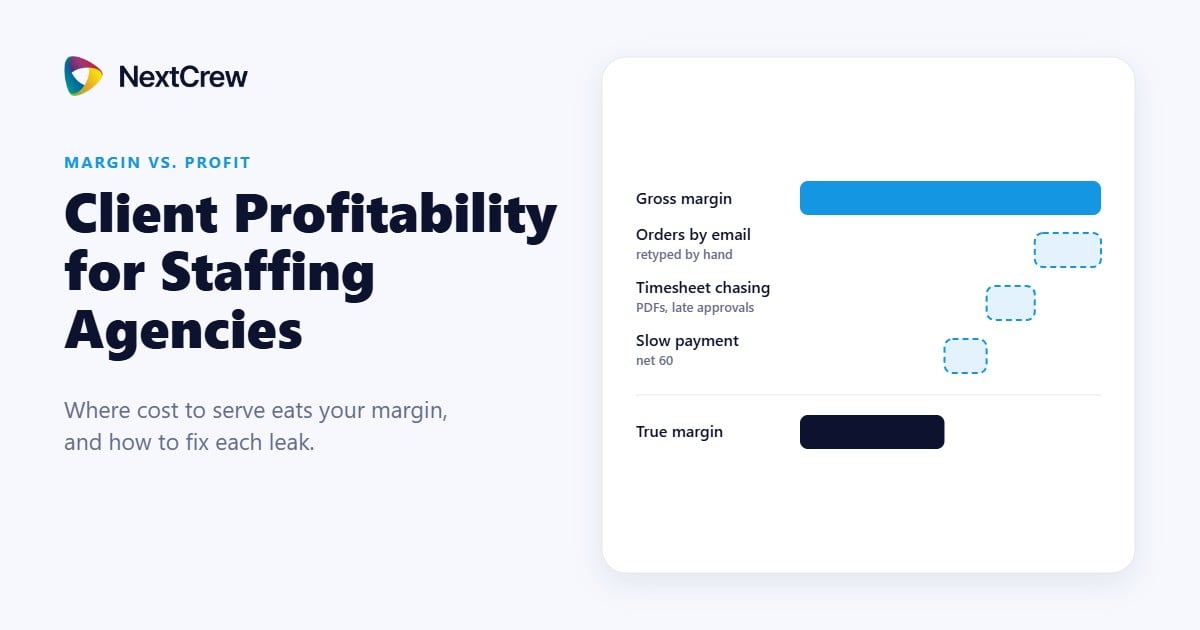
Client profitability is what a staffing agency actually keeps from a client after the cost to serve that client, not just the gross margin on the bill rate. Cost to serve is the team time and cash one client's habits create: orders sent by text or PDF, last-minute requests, timesheets that need chasing, invoices built in the client's own format and slow payment. Almost every one of these leaks can be reduced, but the fix depends on what the client will accept. The practical goal is the best option each client allows, and a rate that covers whatever is left.
Margin is easy to see because it sits on every report. Cost to serve is not, because none of it carries the client's name. That is how the account that looks best on paper keeps getting the best rates, the best Crew and the most attention, while it quietly costs more to run than anyone has measured.
Key takeaways
- True margin is gross margin minus cost to serve. A client with a strong margin can still be one of your least profitable accounts.
- Only count costs that change by client. If a problem happens with every client, it is a process cost, not a client cost.
- Every client is different, so every leak needs more than one fix. The best option is the client working in your system; the fallback is your system reading what they send.
- Some leaks have no software fix. Rebates, discounts and payment terms are fixed at the table: renegotiate them or price them in.
What is client profitability in staffing?
Client profitability is the gross margin a client produces, minus the cost of serving that client. Gross margin is the bill rate minus pay and burden. Cost to serve is everything that one client's way of working adds on top: coordinator hours, rework, premium pay you cannot bill, replacements, fees and the cost of waiting to be paid.
The formula: true margin = gross margin − cost to serve. Rank your clients on both numbers. When the order changes, you know which client conversation to have first.
For the basics of markup, burden and gross margin, and a worked example of two clients that swap places once cost to serve is counted, see how staffing agencies make money. This guide goes one level deeper: where each leak comes from and what you can do about it.
Which costs should count against a client?
Count a cost against a client only if it changes from one client to the next. If Crew Members forget to clock out at every site, that is your process, and it belongs to the whole agency. If one client uses a paper sign-in sheet and will not allow phone clock-in, that cost belongs to that client. Mixing the two hides the clients who really are expensive to serve.
The leaks fall into seven stages of the work. The sections below take them in order.
| Stage | Typical client-driven leaks |
|---|---|
| Ordering | Orders by phone, text, email or PDF; last-minute orders; changes after Crew are confirmed |
| Filling and onboarding | Client-specific requirements; high turnover at the site; frequent do-not-return requests |
| On the job | Paper sign-in sheets; overtime billed at straight time; no-shows and replacements |
| Timesheet approval | Late approvals; hours sent back as a PDF or an email |
| Billing | Invoices in the client's own format; disputes; vendor portal fees |
| Getting paid | Net 45 or net 60 terms; paying late beyond terms |
| The relationship | Manual weekly reports; higher workers' comp cost at the site; rebates and discounts |
Where does margin leak when a client places orders?
Ordering leaks margin through retyping, rushing and rework. Every order that arrives outside your system has to be keyed in by someone, and every detail lost on the way becomes a wrong fill later.
Orders arrive by phone, text, email or PDF
A coordinator reads the message, opens the system and types the job in. A missed start time or a wrong location becomes a Crew Member at the wrong door, a replacement and an awkward call. You pay for the typing and for the mistakes.
Your options, depending on the client
- BestThe client requests staff in your client portal, so the details arrive complete and nobody retypes them. In NextCrew, portal job requests depend on how the client's access is configured.
- BetterThe client's own software sends the orders in through NextCrew's Open API. This suits large clients who will not log in to another system.
- At minimumThe client keeps emailing. Paste the email text into Ask CrewPilot and it creates the job from it, so your coordinator checks the job instead of typing it.
Last-minute orders
An order at the end of the day for the next morning pulls recruiters off everything else and often ends in premium pay or overtime the bill rate never covered. Speed helps: NextCrew's Notify Now sends an open job to the matching Crew at once, so the scramble is shorter. But if one client orders late every week, the lasting fix is commercial: an order cutoff or a rush rate written into the agreement.
Changes after Crew are confirmed
Each change means calls, rescheduling and, in places that require reporting-time pay, hours you pay for nobody worked. Crew Members who are moved around too often stop accepting that client's jobs. Messaging confirmed Crew in one place, through Channels and direct messages in the Crew app, cuts the calling. The cancellation window itself belongs in the contract.
What does a client cost you while you fill and onboard?
Filling costs rise with every requirement and every repeat hire one client creates. Extra background checks, drug tests, site credentials and unpaid orientation are often treated as the price of the account, yet they rarely appear in the rate.
- Client-specific requirements. Onboarding packages in NextCrew are completed and signed on the Crew Member's phone, which takes the chasing out. When a credential has expired, NextCrew can prompt the staffing manager or deny the assignment, depending on your settings. See how to prevent scheduling staff with expired credentials. The cost of the extra checks themselves still belongs in the bill rate.
- High turnover and do-not-return requests. Every Crew Member a client turns away is a replacement fill and a re-onboarding. Keeping preferred and do-not-return lists for each client means the next fill starts with people the client already accepts.
- Unpaid orientation or training. Hours you pay that the client does not. There is no software fix for this one: bill it, or price it into the rate.
How does margin leak while Crew are on the job?
On the job, margin leaks through hours you cannot prove and premium hours you cannot bill. Both show up later as rework, disputes or write-offs.
No clock-in, or a paper sign-in sheet
Paper sheets get photographed, texted, retyped and then hunted down again when the client questions the invoice. Each step is coordinator time, and each retyped number is a chance to pay or bill the wrong hours.
Your options, depending on the client
- BestCrew Members clock in and out on the Crew app. A geofence can block clock-ins and clock-outs outside the site, with the radius set by your agency.
- BetterThe client needs a supervisor's signature. When the Crew Member clocks out, a digital timesheet opens on their phone, the supervisor signs it there, and the signed copy is stored and attached to the invoice.
- At minimumThe site insists on paper. Upload the photo or PDF and NextCrew's AI timesheet import reads it and fills in the hours for your team to review.
Overtime billed at straight time
A client keeps Crew Members past the overtime threshold, but the agreement bills every hour at the regular rate. You pay the overtime premium, the burden rises with it, and the client pays the same. Because NextCrew's margin by job includes burden and overtime, this leak shows up as a margin drop on that client's jobs instead of hiding in the payroll total. Overtime and holiday pay codes can also carry their own bill rates, so premium hours bill at premium rates where the agreement allows it.
No-shows and replacements
Some no-shows are your process; some are the site. If Crew Members keep failing to return to one client, ask why before you refill: distance, a difficult supervisor or unpaid waiting time all cost you a replacement every time.
Why do timesheet approvals cost so much margin?
Approval is where hours become invoices, so every delay or format problem here delays cash and adds rework. A client who approves late makes you chase, and a client who sends hours back in their own document makes you retype.
Hours sent back as a PDF or an email
The client approves hours in their own spreadsheet and emails it over. Someone matches each line to a Crew Member and a job, and types it in. Adding hours to the system by hand costs money every cycle, and that money comes straight out of the client's margin.
Your options, depending on the client
- BestThe client approves timesheets in the client portal, on the web or on their phone. Approved hours flow to payroll and invoicing with no retyping.
- BetterThe client's system sends the hours through the Open API, or the client fills in NextCrew's timesheet import template and you import the file.
- At minimumThe client keeps sending PDFs. AI timesheet import reads the document and fills in the hours; your team reviews them before anything is approved.
Late or missing approvals
Every day a timesheet waits is a day added before you can invoice, while payroll still runs on schedule. Approval on a phone removes the usual excuse. If one client is still always late, put an approval deadline in the agreement and say what happens to hours not approved by then.
How does billing a client eat into margin?
Billing leaks margin when one client's invoice has to be rebuilt by hand, questioned or cut by fees.
- Invoices in the client's own format. Split by department, cost center or job, every cycle. In NextCrew the invoice template is set once per client, grouped by order, department, position or job, and applied automatically every cycle.
- Disputes and short payments. Most disputes are about proof. Attaching the signed timesheets to the invoice automatically answers the question before the client asks it.
- Vendor portal fees and PO numbers. A program fee comes off the top before you are paid, and a missing PO number rejects the invoice. These are contract terms: renegotiate them, or price the fee into the rate.
What does slow payment cost a staffing agency?
Slow payment costs the money you borrow, or the cash you tie up, to meet payroll while you wait. You pay Crew Members every week. A client on net 60 means you fund eight or more weeks of payroll for that client before the first dollar arrives, and every day beyond terms adds to it. If you use payroll funding, that fee comes straight out of the client's margin.
Two things help. Invoice the day hours are approved, not at month end, and work the accounts receivable aging report on a fixed cadence. NextCrew sends automated invoice follow-ups, and its Financial AI watches each client's payment pattern against their own history and flags when one starts paying slower. Financial AI is rolling out one account at a time. The terms themselves are a negotiation: shorter terms, a deposit for events, or a rate that covers the wait.
What else does the relationship cost?
| Leak | What it costs you | What helps |
|---|---|---|
| Manual weekly reports | Coordinator hours every week | The client sees orders, hours and spend in the client portal themselves |
| Higher workers' comp cost at the site | Burden that differs by client, hidden in an average | The workers' comp code is set on each order, so margin by job reflects it |
| Rebates and early-payment discounts | Margin given back after the fact | No software fix: renegotiate or price it in |
| Unemployment claims when assignments end | A higher state unemployment rate on every hour | No software fix: plan assignment endings and price the risk |
How do you calculate profit by client?
Start with your top five clients and one month of data. Rough numbers are fine. The point is the ranking, not the decimal places.
-
1
Get gross margin per client
Use dollars, not only percent, and make sure burden and overtime are in it. A blended average across clients hides the one that loses money.
-
2
Estimate team hours per client
Ask coordinators and billing how many hours a week each client takes: order entry, changes, timesheet chasing and invoice rework. Multiply by a loaded hourly cost.
-
3
Add the money you pay and cannot bill
Overtime billed at straight time, rush premiums, unpaid orientation, replacements and fees taken off the invoice.
-
4
Add the cost of waiting to be paid
Average days to pay × weekly payroll for that client × your cost of money, whether that is a funding fee or the interest on a credit line.
-
5
Rank twice and compare
Rank by gross margin, then by true margin. The clients who move down the list are where the next conversation starts.
What should you do with an unprofitable client?
You have three moves, and walking away is rarely the first one. Most unprofitable clients become profitable once one or two leaks are closed.
| Move | When it fits | Examples |
|---|---|---|
| Renegotiate | The leak is a contract term | Payment terms, cancellation window, overtime billing, order cutoff |
| Fix it with process or a system | The leak is how the work moves | Portal ordering, phone clock-in, online approval, client-specific invoice templates |
| Price it in | The client will not change, and you want the account | A rush rate, a higher markup, a fee for their invoice format |
Bottom line: do the ranking before your next rate renewals. A client conversation backed by numbers is a business discussion; one without them is a complaint.
Where does NextCrew fit?
NextCrew shows margin by job, including burden and overtime, and gives you more than one way to close each leak, because no two clients work the same way. The same approved timesheet feeds payroll and the invoice, so hours are entered once. Clients who will work in the portal request staff, approve hours and see their own reports there. Clients who will not can send data through the Open API. And clients who still email PDFs can keep doing it, because Ask CrewPilot and AI timesheet import read what they send so your team checks instead of types. Decisions on rates and terms stay with you.
See how approved hours turn into client-ready invoices, with margin by client visible as they close, in invoicing software for staffing agencies.
Related reading How Do Staffing Agencies Make Money? Markup and Margin