
How Do Staffing Agencies Make Money? Markup and Margin
Updated · 7 min read
Staffing agencies make money mainly by charging clients a bill rate that is higher than the pay rate they pay the Crew Member, then keeping what is left after employer costs. That spread is called gross margin. Agencies also earn one-time fees when a client hires a temp permanently (a conversion fee) or hires a candidate the agency found (a placement fee), and some charge a smaller fee to run payroll for people the client already recruited. But a high margin does not guarantee a profitable client: what it costs your team to serve that client decides what you actually keep.
Key takeaways
- Markup is not profit. Markup is added to pay; employer costs (burden) come out of it before anything counts as gross margin.
- There are four common revenue models. Temp markup on pay, temp-to-hire conversion fees, direct hire placement fees and payrolling.
- High margin is not always high profit. Timesheet corrections, invoice disputes, last-minute orders, coordinator hours and slow payment can erase a client's margin.
- Profit grows from three levers. Regular rate reviews, less rework and faster invoicing usually do more than chasing new volume.
What are the four ways a staffing agency earns revenue?
Most staffing agencies earn revenue from four models, and most mix at least two of them.
| Model | How the agency gets paid | Who is on payroll |
|---|---|---|
| Temporary staffing | A markup on the pay rate, billed every hour worked | The agency |
| Temp-to-hire | Markup during the trial period, then a conversion fee if the client hires early | The agency, then the client |
| Direct hire | A one-time placement fee, often a share of first-year salary | The client |
| Payrolling | A smaller markup to employ people the client recruited (payrolling) | The agency |
Payrolling carries a lower markup because the agency did not recruit anyone, yet it still carries the employer costs and the payment risk. Conversion and placement fee terms live in your staffing agreement.
How do markup, bill rate, burden and gross margin fit together?
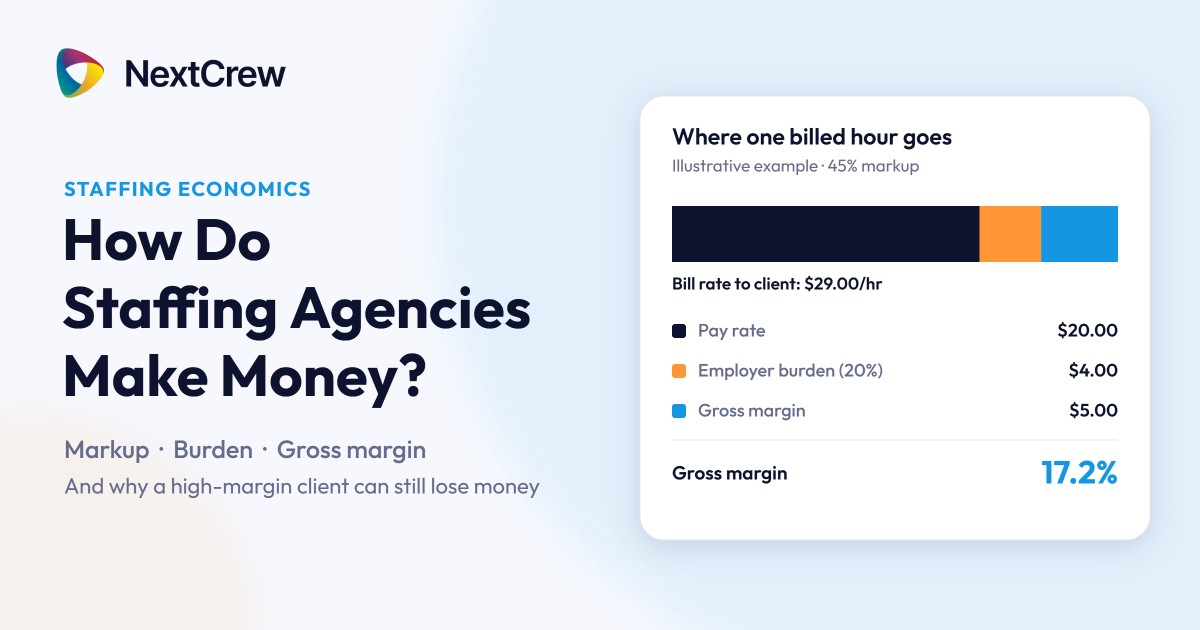
Markup is added to the pay rate to set the bill rate, burden is subtracted, and what remains is gross margin. The bill rate is what the client pays per hour. The burden rate covers employer costs on top of wages: FICA, federal and state unemployment tax, workers' comp and any benefits. Gross margin is the bill rate minus pay minus burden, shown in dollars per hour or as a percentage of the bill rate.
Illustrative example
| Line | How it is calculated | Per hour |
|---|---|---|
| Pay rate | Paid to the Crew Member | $20.00 |
| Markup | 45% of pay | $9.00 |
| Bill rate | Pay + markup | $29.00 |
| Burden | 20% of pay (example only) | $4.00 |
| Gross margin | Bill − pay − burden | $5.00 (17.2% of bill) |
| One 40-hour week | $5.00 × 40 | $200 before overhead |
A 45% markup became a 17.2% gross margin, and that $200 a week still has to pay recruiters, coordinators, rent, insurance and software before any of it is profit. Burden differs by state, claims history and workers' comp class code, so the same markup produces different margins on different positions. This is general information, not tax or legal advice; confirm your burden with your accountant.
What are typical staffing agency markup rates and profit margins?
There is no reliable free public benchmark for the average markup for staffing agencies, and the best-known margin figures come from large public firms. Staffing Industry Analysts reported that across 15 publicly traded staffing companies, average gross margin was 27.9% in 2022, after holding at about 25% from 2006 to 2020, and that at least two of those firms tied their margin gains to more permanent placement business (SIA, August 23, 2023). That blend of temp and fee revenue is why the figure should not be read as a target for a temp-heavy local agency.
Staffing agency markup rates and staffing agency profit margins move with four drivers:
- Revenue mix. Placement and conversion fees have no pay or burden against them, so more fee revenue lifts the blended margin.
- Burden by position. A warehouse role with a costly workers' comp code keeps less of the same markup than an office role.
- Skill scarcity. Hard-to-fill, credentialed roles support higher bill rates than high-supply general labor.
- Buying channel and volume. Large-volume accounts and managed programs usually negotiate the markup down.
The useful benchmark is your own: gross margin by client and by position, tracked month over month.
Why can a high-margin client still lose money?
A client can show the best margin on your report and still be one of your least profitable accounts, because gross margin ignores the cost to serve. Every corrected timesheet, disputed invoice, rush order and late payment takes team time that never appears on the margin line. As you plan for 2027, ask this question of every account.
Illustrative example
| Per week | Client A | Client B |
|---|---|---|
| Hours billed | 400 | 400 |
| Gross margin per hour | $5.00 | $4.50 |
| Gross margin | $2,000 | $1,800 |
| Coordinator hours (corrections, disputes, rush orders) | 14 | 3 |
| Cost of that time at $30/hour | $420 | $90 |
| Margin after cost to serve | $1,580 | $1,710 |
| Pays invoices in | 75 days | 30 days |
Client A wins on margin and loses on profit. It also ties up cash for more than twice as long, and you meet payroll every week regardless.
How do you score client profitability?
Score each client on gross margin dollars plus five cost-to-serve factors, reviewed at least quarterly.
| Factor | What to measure | Warning sign |
|---|---|---|
| Gross margin dollars | Margin per month, not just percentage | High percentage on low hours |
| Timesheet corrections | Timesheets changed after submission | Approvals arrive late or get reopened |
| Invoice disputes | Invoices questioned or reissued | Same disputes every cycle |
| Last-minute orders | Job orders placed inside 24 hours | Rush is the norm, not the exception |
| Coordinator hours | Team time spent on the account weekly | Rising time on flat hours billed |
| Slow payment | Average days to pay, from AR aging | Regularly past terms |
How can a staffing agency raise profit?
The fastest gains usually come from pricing the accounts you already have correctly and removing rework, not from adding volume. The steps below work on any profit margin for staffing agencies, small or large.
-
1
Run rate reviews every year
Pay rates, unemployment tax rates and workers' comp costs change. If the bill rate does not move with them, margin shrinks quietly.
-
2
Price the cost to serve
Where a client's scorecard runs red, add a rush-order rate, tighten order cutoffs or shorten payment terms before you consider walking away.
-
3
Reduce rework at the source
Most corrections and disputes start with hours captured on paper or approved after the fact. Digital clock-in and client approval before invoicing prevent them.
-
4
Invoice faster
Every day between approved hours and a sent invoice is a day added to your cash gap. Invoice weekly from approved timesheets and work the AR aging report on a fixed cadence.
For the full set of numbers to track alongside margin, see our guide to evaluating key staffing metrics.
How NextCrew fits
NextCrew keeps the numbers behind margin in one place, so you can see which clients make money instead of guessing. Pay and bill rates are configured by client, position and job, including differentials and overtime. Crew Members clock in from the app, a kiosk or a supervisor, clients approve timesheets in the client portal, and approved timesheets flow into invoices built in batches with per-client billing rules, with no re-entry. That is how staffing invoicing software cuts both rework and the delay before you bill.
Dashboards rank clients by revenue and margin, and AR aging and outstanding invoices reports show who pays slowly, which covers the margin and payment rows of the scorecard. See staffing reporting and analytics. The decision to reprice, renegotiate or let a client go stays with you.
Frequently asked questions
Sources
Staffing Industry Analysts, "Average gross margin rises at 15 publicly traded staffing firms," August 23, 2023, citing the SIA report Gross Margin and Bill Rate Trends. staffingindustry.com