
Workers' Comp for Staffing Agencies: Costs, Codes, Options
Updated · 7 min read
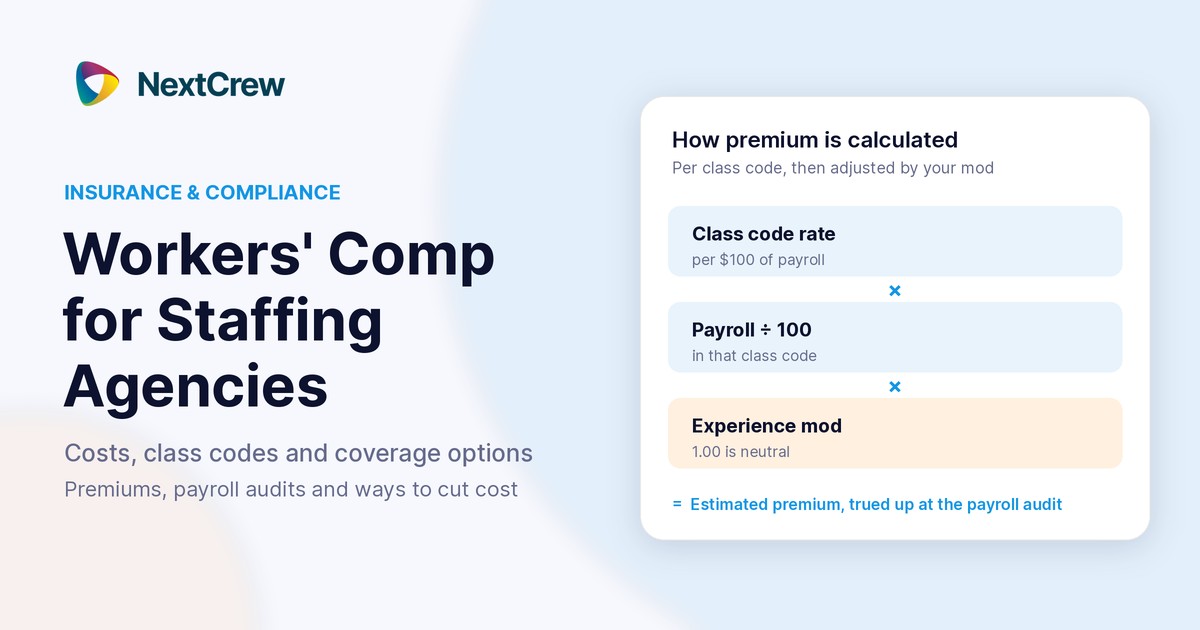
Workers' comp for staffing agencies is a workers' compensation policy the agency carries, as employer of record, for the temps it places at client sites. Premium is usually the class code rate per $100 of payroll, times that payroll, times the agency's experience mod. It is harder to get than for most businesses because one agency carries many class codes, works on sites it doesn't control and has volatile payroll. Accurate codes per position, safer sites and fast claims handling keep it affordable.
Key takeaways
- The agency usually carries the policy. As the employer of record it covers its temps, and the staffing agreement should say so in writing.
- Temps take the client's class code, not a "temp" code. In rating rules based on the NCCI manual, they are classified like the client's own employees doing the same work.
- The payroll audit settles the bill. Payroll reported under the wrong code gets reclassified, and the difference comes due at the end of the policy term.
Do staffing agencies need workers' comp, and who covers the temps?
Yes. A staffing agency that employs and pays its temps generally has to cover them under workers' compensation, just as any employer covers its own staff. The agency pays them and issues the W-2, so it normally carries the policy. The client directs the work, so put the split of responsibility in the staffing agreement: who carries coverage, which certificate the client gets, and who handles site safety and training.
Many clients also ask for an alternate employer endorsement on the agency's policy. NCCI's form WC 00 03 01 A extends the agency's coverage to its people while at a named client, treats that client as if it were the named insured and waives subrogation against it, but doesn't replace the client's duty to carry its own coverage (FC&S Editors, PropertyCasualty360, January 2014). In California, Labor Code section 2810.3 (AB 1897, signed September 2014) makes a client employer share liability when a labor contractor fails to provide valid workers' comp coverage. Workers' comp is one piece of staffing agency insurance.
How are workers' comp premiums calculated for a staffing agency?
Premium starts with the rate for each class code, applied to every $100 of payroll in that code, then multiplied by the agency's experience modification factor. NCCI's ABCs of Experience Rating (2025) describes it this way: each state approves a rate per classification, each $100 of payroll is multiplied by that rate, and the experience mod then adjusts the total. A mod of 1.00 is neutral; above 1.00 raises premium and below lowers it. The mod compares your losses, usually over three years, with similar employers, and a new business starts at 1.00.
For a staffing agency, the hard part is classification. The NCCI-based Basic Manual published by the North Carolina Rate Bureau (Rule 1, covering labor contractors and temporary labor services) says leased and supplied staff "must be classified the same as direct employees of the client performing the same or similar duties." A forklift operator and a receptionist at the same client carry different codes. See workers' comp class codes for how codes are assigned.
Illustrative example (made-up rates; real rates vary by state, code and carrier): an agency has $1,000,000 of warehouse payroll at a rate of $4.00 and $200,000 of office payroll at $0.20. Its experience mod is 1.20.
Warehouse: 10,000 × $4.00 = $40,000. Office: 2,000 × $0.20 = $400. Subtotal $40,400 × 1.20 mod = $48,480 before other charges and discounts.
This premium is part of your burden rate and belongs in every bill rate.
Not every state follows this pattern. NCCI's experience rating plan doesn't apply in California, Delaware, Michigan, New Jersey, New York or Pennsylvania, and Washington bases most premiums on hours worked rather than payroll (Washington State Department of Labor & Industries, "Unique Premium Rating Features in Washington," February 2024).
Why do traditional workers' comp brokers decline staffing agencies?
Traditional brokers decline staffing agencies because the risk is harder to underwrite than a business with one location and one main class code.
- Many class codes. Each client and position can carry its own code.
- Client site risk. The agency carries the claim, but the client controls the equipment, the floor and the supervision.
- Payroll volatility. A new warehouse client can double payroll in a quarter.
- Experience mod. A new agency has no loss history, and a few claims can push a mod into debit for three years.
It bites hardest in light industrial staffing, where warehouse and manufacturing jobs carry higher rates.
What are your options for staffing agency workers' comp insurance?
The right option depends on your state, your size, your mix of class codes and your loss history. In four monopolistic states, North Dakota, Ohio, Washington and Wyoming, employers buy coverage from the state fund rather than a private carrier, unless they qualify to self-insure (NCCI, ABCs of Experience Rating, 2025). Elsewhere, agencies typically choose among these:
| Option | How it works | Usually fits |
|---|---|---|
| Standard market | A regular carrier writes the policy through a broker | Low-hazard codes, clean history |
| Specialty staffing program | A carrier or program built for staffing risk, often with safety requirements | Light industrial agencies declined elsewhere |
| PEO | You join a PEO's master policy and pay through its fees | Small or new agencies |
| State fund | Required in monopolistic states; a competing or last-resort option in some others | Monopolistic states, or as a fallback |
| High deductible or self-insured | You fund claims up to a set amount, with collateral and state approval where required | Large, well-capitalized agencies |
For workers' comp for staffing agencies in California, use a broker who knows the WCIRB system, since California sets its own codes and experience rating.
How do payroll audits work, and why do misclassified positions cost money?
Your premium is billed on estimated payroll, then a payroll audit at the end of the term compares it with actual payroll by class code and bills or refunds the difference. Payroll reported under a cheaper code than the work deserved is moved to the right code and charged at that rate.
Watch out
Illustrative example, using the made-up rates above: if $200,000 of warehouse payroll was reported as office payroll, the audit moves it to the warehouse code. That adds 2,000 × ($4.00 − $0.20) = $7,600, or $9,120 after the 1.20 mod, in one bill, on margin already spent.
How can a staffing agency control workers' comp costs?
You control cost by preventing injuries, closing claims quickly and reporting payroll under the right codes. OSHA says staffing agencies and host employers are jointly responsible for a safe workplace for temporary staff, with the agency typically giving general training and the host site-specific training (OSHA, "Protecting Temporary Workers").
-
1
Walk the client site before the first job
Check equipment, hazards and supervision, and reprice or decline riskier work.
-
2
Train before dispatch, and document it
Give general safety training and get the client's written agreement to train on its own equipment.
-
3
Assign a class code to every position
Confirm each code with your broker on new orders and when duties change.
-
4
Report claims the same day
Give clients and Crew one way to report injuries.
-
5
Run a return-to-work program
Offer light duty matched to medical limits so injured Crew Members return sooner.
How NextCrew fits
NextCrew doesn't assign class codes, sell insurance or calculate workers' comp premiums; your broker and carrier do that. It keeps your codes and payroll records organized for the audit. You set the workers' comp code on each order, so every job carries the code for the work being done.
When the auditor asks for payroll by class code, the code on each order and the hours from approved timesheets are already in one system rather than spread across spreadsheets. Agencies running warehouse and manufacturing accounts can see how this works on the industrial staffing software page.
Frequently asked questions
Sources: NCCI, ABCs of Experience Rating, 2025. North Carolina Rate Bureau, Basic Manual, Rule 1, Assignment of Classifications (accessed October 2026). FC&S Editors, "Alternate Employer Endorsement," PropertyCasualty360, January 2014. Washington State Department of Labor & Industries, "Unique Premium Rating Features in Washington," February 2024. OSHA, "Protecting Temporary Workers" (accessed October 2026). California Labor Code section 2810.3, as added by AB 1897 (2014).
This article is general information, not legal or insurance advice. Confirm coverage, class codes and state rules with your broker, carrier and attorney.