
Staffing Industry Trends 2027: What to Plan For
Updated
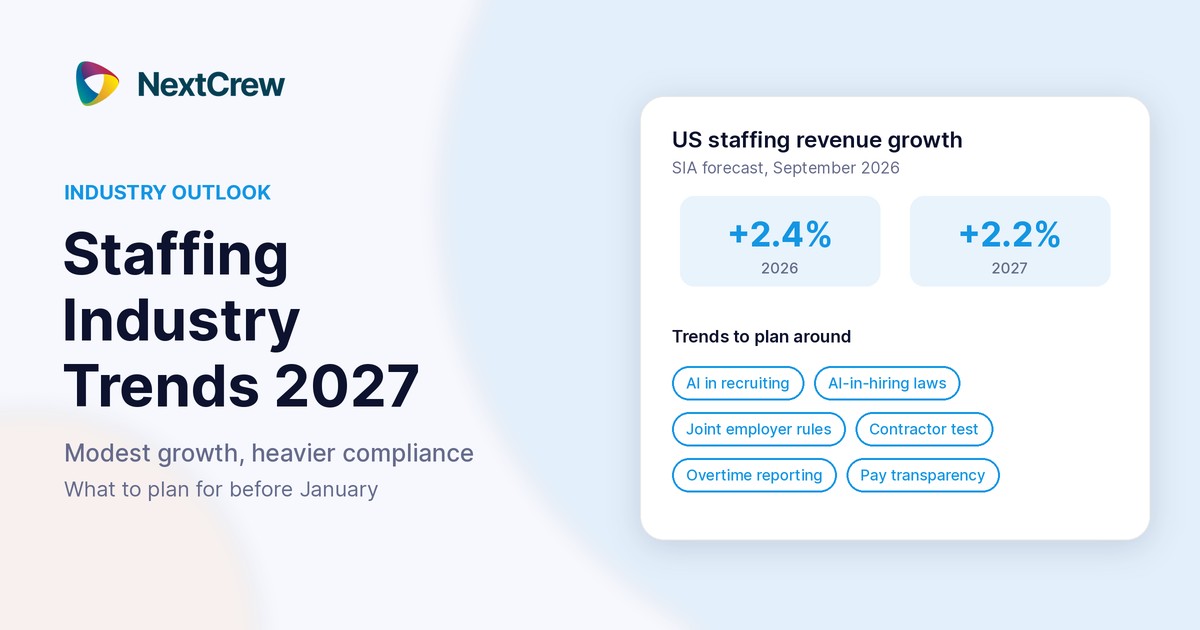
Staffing industry trends 2027 point to modest, uneven growth and a heavier compliance load, not a boom. Staffing Industry Analysts (SIA) projects US staffing revenue will grow 2.4% in 2026 to $183.1 billion, then 2.2% in 2027 (SIA, September 2026). Eight trends to plan around: slow demand growth, industrial and per diem healthcare leading, AI in daily recruiting, AI-in-hiring laws, a redrawn joint employer line, a changing independent contractor test, "no tax on overtime" W-2 reporting, and wider pay transparency. Agencies that fill faster and keep cleaner data will win 2027, and that work starts before January.
Key takeaways
Is staffing demand actually growing going into 2027?
Yes, slowly. SIA raised its 2026 estimate to 2.4% from 0.8%, still below the $243 billion peak of 2022 (SIA, September 2, 2026). The ASA Staffing Index showed temporary and contract employment 4.4% higher year over year for the four weeks ending August 16 (American Staffing Association, August 25, 2026). Federal data is flatter: temporary help employment was about 2.49 million in September 2026, down 10,900 from August and up 0.6% year over year (BLS, October 2, 2026).
What it means for your agency: a 2% market does not lift every agency. Growth comes from winning share.
What to do before January: plan on a low single-digit baseline and set fill rate and gross margin targets by client. Our step-by-step guide to staffing metrics covers what to track.
Which staffing segments are leading?
Industrial leads, and healthcare is stabilizing rather than rebounding. SIA estimates industrial at $40.9 billion, growing 7% in 2026, while healthcare grows 1% to $40.1 billion after three years of decline (SIA, September 2, 2026). In June 2026, median growth was 4% for allied, 3% for per diem nursing and 1% for travel nursing (SIA Pulse Survey, August 17, 2026).
What it means for your agency: in the growing segments, speed to fill and clean credentials win the order.
What to do before January: rank clients and verticals by margin and aim first-quarter sales effort accordingly.
How is AI changing day-to-day staffing work?
AI is moving into everyday screening and matching, but full automation is rare. Most agencies now use AI somewhere in recruiting, usually inside the applicant tracking system for screening and matching, while end-to-end automation of the whole workflow is still uncommon.
What it means for your agency: the gap is between agencies using AI daily and those still testing. AI flags and ranks; recruiters decide.
What to do before January: pick two workflows, such as resume parsing and matching, and measure time to fill before and after.
Not legal or tax advice: the next five sections are general information as of October 2026. Confirm how they apply with employment counsel and your payroll or tax advisor.
What new rules apply to AI in hiring?
State AI-in-hiring laws are arriving. Illinois' AI amendments took effect January 1, 2026. Colorado's law takes effect January 1, 2027, requiring prior notice, an explanation within 30 days of an adverse decision, human review on request and three years of records. Connecticut requires written notice for automated hiring tools from October 1, 2027 (Husch Blackwell, July 2026).
What it means for your agency: when your team screens applicants with AI, your agency is the one using the tool.
What to do before January: list your AI hiring tools, draft notice language and document human review.
Is the joint employer line moving?
Yes, at two agencies at once. The NLRB finalized a rule on February 26, 2026 requiring "substantial direct and immediate control" over essential terms of employment (Benesch, February 27, 2026). The Department of Labor proposed an FLSA joint employer rule in April 2026 on four factors: hiring and firing, substantial control of schedules, setting pay, and keeping records, with staffing arrangements among the most affected (K&L Gates, April 27, 2026). We found no final DOL rule as of early October 2026.
What it means for your agency: the co-employment split with each client turns on who actually controls schedules, pay and records.
What to do before January: check staffing agreements against those four factors.
Is the independent contractor test changing?
It may, but the federal change is still a proposal. The DOL proposed on February 26, 2026 to return to a modified 2021 test, with control and opportunity for profit or loss as core factors (Maynard Nexsen, February 27, 2026). The DOL's rulemaking page still showed it as a proposal in October 2026.
What it means for your agency: state law still applies, and most temporary staff remain W-2 employees. See W-2 vs 1099 for staffing agencies.
What to do before January: do not reclassify anyone on a proposal; review existing 1099 arrangements.
What does "no tax on overtime" mean for staffing payroll?
Starting with 2026 W-2s, employers must report qualified overtime compensation in Box 12 with Code TT. Qualified overtime is generally the half-time premium on FLSA-required overtime, and the deduction is capped at $12,500, or $25,000 joint (IRS FS-2026-13, August 6, 2026, via HRMorning, August 18, 2026).
What it means for your agency: 2026 W-2s go out in January 2027, and high-overtime payrolls carry the most risk.
What to do before January: confirm your payroll provider has mapped Code TT and that timesheets separate overtime cleanly.
Where is pay transparency expanding?
More job postings will need pay ranges in 2027. California's amendments took effect January 1, 2026, Columbus, Ohio enforces from January 1, 2027, and Delaware's law starts September 26, 2027 for employers with more than 25 employees (Baker Donelson, January 21, 2026; L&E Global, February 25, 2026).
What it means for your agency: high-volume agencies post constantly, so every template is exposed.
What to do before January: make pay range a required posting field for covered locations.
What do these trends mean by vertical?
Each vertical feels them differently.
| Vertical | What the latest data shows | What to watch in 2027 |
|---|---|---|
| Light industrial | $40.9B, +7% in 2026 (SIA, Sep 2026) | Joint employer factors; overtime reporting |
| Healthcare | +1% to $40.1B; per diem +3%, allied +4% (SIA, 2026) | Credential expiry at volume; AI screening notices |
| Hospitality and events | Leisure and hospitality +62,000 jobs in August 2026, flat in September (BLS) | Pay ranges on postings; peak-event overtime |
| Education | Expected to peak in 2026 at $4.4B (SIA, Sep 2026) | Whether 2027 holds that level |
What should be on your 2027 readiness checklist?
Eight items cover most of it.
- Plan on a 2% market with client-level targets.
- Rank clients by margin and target growing segments.
- Inventory AI tools and add notices.
- Review staffing agreements for control factors.
- Hold classification steady until rules are final.
- Confirm Code TT with your payroll provider.
- Add pay ranges to covered postings.
- Run a 90-day credential expiry review before January.
How does NextCrew fit into 2027 planning?
NextCrew connects the work these trends touch, so your data is clean when rules and clients ask for it. Crew Members clock in from the Crew app with GPS and geofencing, clients approve timesheets in the client portal, and approved timesheets flow to invoicing and payroll export without re-entry. Overtime is configured by client, position and job; your payroll provider still calculates taxes and W-2s. CrewPilot AI parses resumes, ranks matches and surfaces credential gaps and no-show risk; recruiters decide. For healthcare, NextCrew keeps every expiry visible across the pool and flags what's lapsing well ahead.
Frequently asked questions
Sources
- SIA, US Staffing Industry Forecast: September 2026 Update, September 2026
- SIA, Staffing industry seeing growth for first time in 3 years, Sep 2, 2026
- SIA, Healthcare staffing returns to modest growth across most segments, Aug 17, 2026
- SIA, August 2026 US Jobs Report, Sep 2026
- American Staffing Association, Staffing Index Grows in August, Aug 25, 2026
- BLS, The Employment Situation: September 2026, Oct 2, 2026
- Husch Blackwell, Byte Back: Colorado and Connecticut AI obligations for employers, Jul 2026
- Benesch, NLRB and DOL Publish Significant Rules Governing Joint Employment, Feb 27, 2026
- K&L Gates, DOL Proposes New Rule on Joint Employer Status, Apr 27, 2026
- Maynard Nexsen, USDOL's 2026 Proposed Independent Contractor Rule, Feb 27, 2026
- HRMorning, IRS Releases Updated W-2 Guidance for Reporting Qualified Overtime, Aug 18, 2026
- Baker Donelson, Pay Transparency in 2026, Jan 21, 2026
- L&E Global, Navigating 2026 Pay Transparency Laws, Feb 25, 2026