
Payroll Funding for Staffing Companies: How It Works
Updated · 7 min read
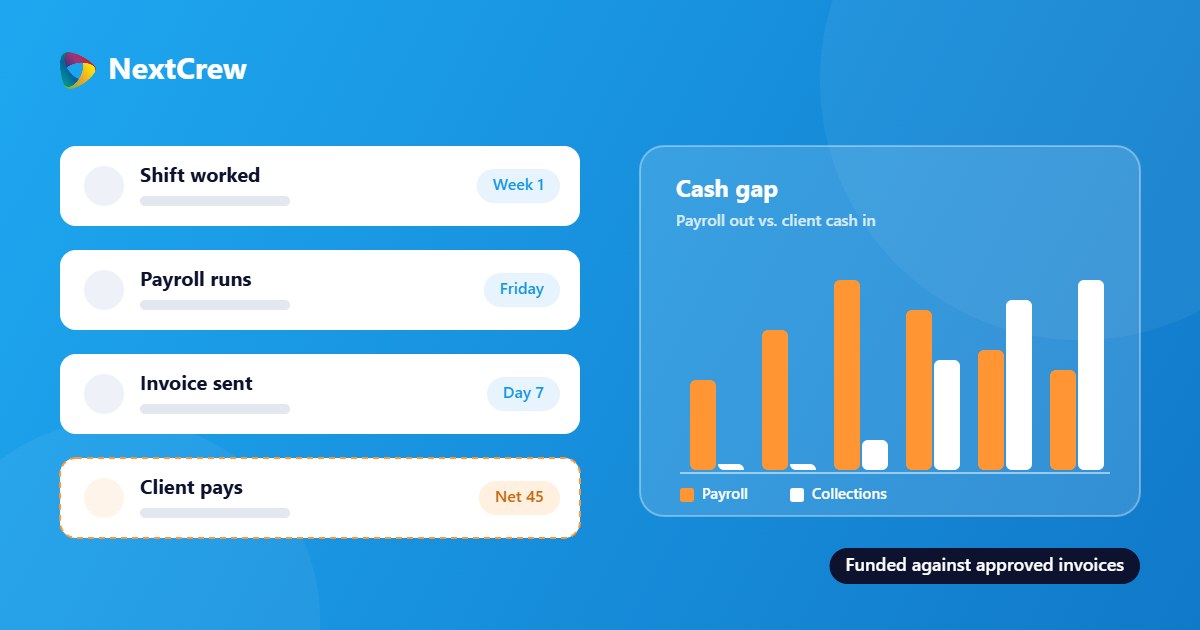
Payroll funding for staffing companies is financing that advances cash against unpaid client invoices so an agency can pay its Crew every week while clients take 30 to 60 days to pay. It usually works like invoice factoring: a funder advances most of each invoice's value, collects from the client, then releases the rest minus a fee. Before signing, compare it with a bank line of credit and asset-based lending, read the contract terms closely, and shrink the gap itself by invoicing faster and cutting disputes.
Key takeaways
- The gap is structural. Staffing agencies pay Crew weekly and get paid on net 30 to 60 terms, so growth uses up cash before it produces any.
- The fee is only part of the cost. Contract length, minimums, termination terms, liens and who collects from your clients matter as much as the rate.
- Every day you invoice sooner shrinks the gap. Invoicing the day timesheets are approved and getting client approval up front reduces how much you need to borrow.
Why do staffing agencies need payroll funding?
Staffing agencies need payroll funding because they pay Crew before clients pay them. Crew Members expect pay every week. Clients pay on net 30 to 60 terms, sometimes late. Meanwhile the agency covers wages, employer payroll taxes and insurance from its own cash. Each new client or bigger order makes the gap wider, which is why a growing agency can be profitable and still short of cash.
This isn't unique to staffing. In the Federal Reserve Banks' 2025 Report on Employer Firms (March 2025, from the 2024 Small Business Credit Survey), 56% of employer firms said paying operating expenses such as payroll was a challenge in the prior 12 months, and 51% cited uneven cash flows. Staffing has a sharper version, because payroll is most of its cost. Payroll funding is the industry's name for financing built around that pattern.
How big is your cash gap?
Your cash gap is roughly your weekly payroll cost multiplied by the number of weeks between paying Crew and getting paid by the client. Use your fully loaded payroll cost (wages plus employer taxes and insurance), not your billings, because cost is the cash that actually leaves the account.
Illustrative example: an agency's weekly payroll cost is $40,000. Clients are on net 45 and pay about 10 days late on average, so 55 days pass between paying Crew and collecting.
Cash gap = $40,000 × (55 ÷ 7) ≈ $314,000 tied up at any moment.
Each day of delay costs about $40,000 ÷ 7 ≈ $5,700. If invoices go out a week sooner, the gap drops by about $40,000.
How does payroll funding compare with invoice factoring, a line of credit and ABL?
Payroll funding and invoice factoring for staffing agencies are often the same arrangement under different names. The agency sells or pledges its invoices to a funder and gets most of their value up front. The share advanced is the advance rate. The funder holds the rest as a reserve and releases it, minus fees, when the client pays. Some funders add back-office services such as payroll processing, invoicing and collections.
The key contract term is recourse. With recourse factoring, if a client doesn't pay within a set period, you buy the invoice back or replace it. With non-recourse factoring, the funder takes certain losses, but often only the ones its contract defines, such as a client's insolvency, not a dispute over hours. Non-recourse usually costs more. Payroll financing for temp staffing comes in four main forms:
| Option | How it works | Cost structure | Usually fits |
|---|---|---|---|
| Payroll funding | Staffing-focused funder advances against invoices; often bundles payroll, invoicing and collections | Fee on invoice value, sometimes plus service fees | New or fast-growing agencies with little credit history |
| Invoice factoring | You sell invoices; advance now, reserve later; recourse or non-recourse | Discount fee that often rises the longer an invoice stays unpaid | Agencies with creditworthy clients and a short track record |
| Bank line of credit | Revolving loan you draw and repay; you keep collections | Interest on what you draw, often the lowest cost | Established agencies with financial statements and personal guarantees |
| Asset-based lending (ABL) | Credit line sized to a borrowing base of eligible receivables | Interest plus reporting, audit and monitoring costs | Larger agencies with clean reporting and steady volume |
What does payroll funding cost?
Payroll funding costs more than bank credit, and the real cost depends on how quickly your clients pay as much as on the quoted rate. Many funders charge a percentage of each invoice for a set period, then more for each extra period it stays unpaid, so slow payers raise your cost. Application, due diligence, wire, lockbox, minimum-volume and termination fees can add to it. To compare offers, take one realistic invoice, apply your clients' actual days-to-pay and every fee in the agreement, and turn the total into an annual cost.
What should you ask a payroll funding company before signing?
Ask questions that show the whole contract, not just the headline rate.
- Contract length. How long is the term, does it auto-renew, and what does it cost to leave early?
- Minimums. Is there a monthly volume minimum, and what happens if a slow season puts you under it?
- Fees. What is the full fee schedule in writing, and how is the fee charged as an invoice ages?
- Notification to clients. Will clients get a notice telling them to pay the funder, and what will it say?
- Who owns collections. Who contacts your clients about overdue invoices, and how? Your client relationships are your business.
- Eligibility and reserves. Which clients will they fund, are there limits on how much one client can be, and when are reserves released?
Warning signs
Be careful if a funder won't put every fee in writing, wants a lien on all your business assets when you're only factoring receivables, pairs a long auto-renewing term with a large exit fee, quotes an advance rate that shrinks once reserves and holdbacks are taken out, or pushes you to sign before your accountant or attorney has read the agreement.
How can you shrink the cash gap yourself?
You shrink the gap by starting the payment clock sooner and removing reasons for clients to pay late. These steps help whether or not you use a funder, and with a funder they lower your fees.
-
1
Invoice the day timesheets are approved
Net 30 starts when the client receives the invoice, so a week spent building invoices is a week added to your gap.
-
2
Send consolidated invoices
A consolidated invoice rolls a period's jobs into one bill per client, which is easier for accounts payable to approve than a stack of small ones.
-
3
Get client approval before you bill
When the client's supervisor approves hours in a portal, disputes are settled before the invoice exists, not 40 days after it.
-
4
Track AR aging every week
An accounts receivable aging report shows who is drifting past terms while a phone call can still fix it.
-
5
Put terms and deposits in the staffing agreement
Set payment terms, late fees, approval deadlines and, for new or high-risk clients, a deposit in the staffing agreement before the first job starts.
How NextCrew fits
NextCrew doesn't fund payroll or offer financing; it helps you shorten the gap you would otherwise finance. Clients approve timesheets in the client portal, and approved hours flow into invoicing without re-entry, so timesheet approval and billing happen together rather than days apart.
With staffing invoicing software in NextCrew, invoices are built from approved timesheets in batches using each client's billing rules, and clients can see their invoices in the portal. AR aging and outstanding invoices reports show what is owed and how late it is, so you know your real cash gap whether you use a funder, a bank line or neither.
Frequently asked questions
Sources: Federal Reserve Banks, 2025 Report on Employer Firms: Findings from the 2024 Small Business Credit Survey, March 2025 (survey fielded September to November 2024).
This article is general information, not financial, legal or tax advice. Review any funding agreement with your accountant and attorney.