
Why Staffing Agencies Stop Growing — and the Four-Function System That Fixes It


Most staffing agency owners can tell you exactly what went wrong last week. A client called about a no-show. A worker got paid late. A new order came in, but the bench was thin.


These problems feel random — but they're not.


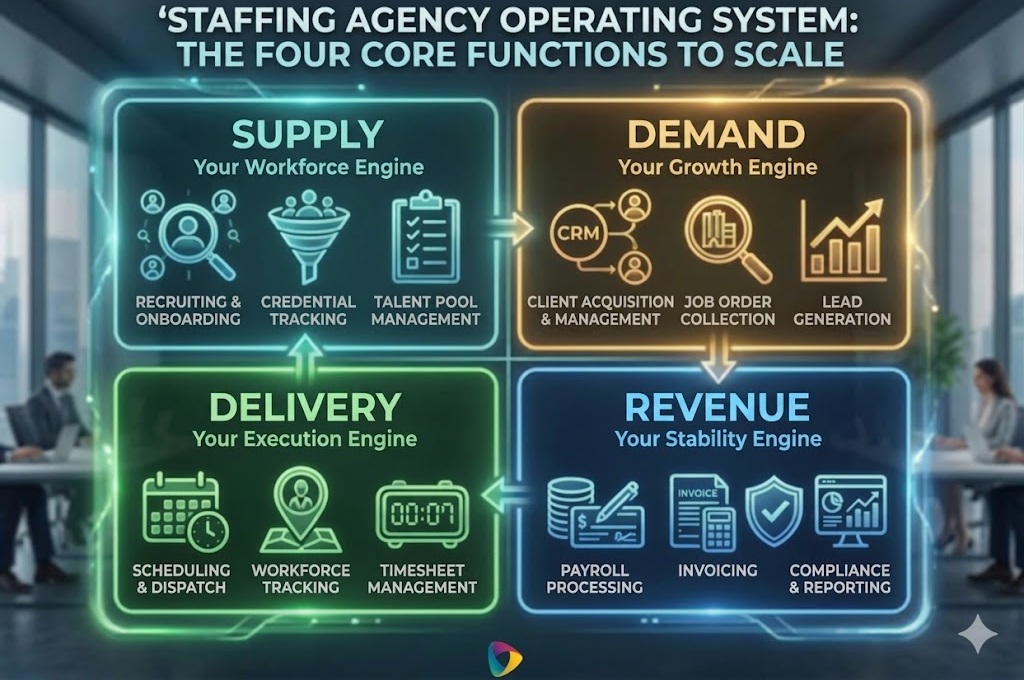
Almost every problem in staffing agency operations links to four core functions: Supply, Demand, Delivery, and Support. When these functions operate together as a system, agencies grow efficiently. When even one falls behind, it creates friction across the entire business.


"This is what we call the staffing agency operating system — a practical framework that helps agencies find exactly what is slowing growth."

Key insight · Staffing Agency Operating System

Why Your Agency's Structure Matters More Than Talent

The American Staffing Association reports that U.S. staffing firms place approximately 16 million temporary and contract workers each year. Many agencies believe growth comes down to better recruiters or stronger sales teams. While talent matters, structure matters more.


The reality is simple: without a system, growth creates complexity — not efficiency. Agencies that scale well don't just hire more people. They improve how supply, demand, delivery, and support work together.


Without this, even strong teams struggle with recurring issues like missed shifts, delayed payroll, or inconsistent client service. This is why many agencies see stalled growth — not because of weak demand, but because operations cannot keep up.


What Most Staffing Agencies Actually Look Like

When you map real-world operations, patterns become clear.


Supply is reactive

Recruiting starts only when demand increases. Onboarding is manual. Credentials are scattered across spreadsheets. No centralized system ensures workers are ready before jobs arrive.


Demand is relationship-dependent

Revenue relies heavily on a few key clients. New business development is inconsistent. There is limited visibility into future demand.


Delivery is manual

Scheduling happens through calls or spreadsheets. No-shows trigger last-minute scrambling. No structured response system exists to manage disruptions efficiently.


Support is fragmented

Payroll delays, invoicing gaps, and reporting inefficiencies create hidden operational risks. Data flows are inconsistent, leading to errors and delays that cascade into every other function.


If this sounds familiar, you're not running a broken agency — you're running a typical one. The question is: can this model support long-term growth?


📖 Related Reading
How to Prevent and Track Staffing No-Shows: A Complete Guide for Agencies Read article →

→ Want to know which of your four functions is holding you back?

The Staffing Agency OS Audit is a free 16-question self-assessment — 4 questions per function — covering Supply, Demand, Delivery, and Support. You score each answer on a 1–5 scale, and a scoring guide tells you exactly which function is creating the most drag and where to focus first. It takes about 10 minutes and is designed for agency owners who want an honest read on their operation.


What a Well-Structured Staffing Agency Looks Like

A high-performing agency operates differently.


  • Workers are recruited, onboarded, and ready before demand arises
  • Shift coverage is managed proactively — not reactively after a gap appears
  • Clients are managed with visibility into their upcoming needs
  • Jobs are dispatched and tracked in real time
  • Back-office processes run smoothly because data is accurate from the start

The difference isn't talent — it's a system.


The Four Core Functions of the Staffing Agency Operating System

Each function has a specific role — and a predictable failure point.


⚙️ Supply — Your Workforce Engine

A well-run Supply function has a structured recruiting pipeline with multiple active sources, onboarding completed before the first shift, credentials tracked automatically, and a talent pool you can query by skill, certification, location, and availability. Agencies that struggle here act reactively — recruiting only when they urgently need workers, not before.
📈 Demand — Your Growth Engine

A well-run Demand function tracks every client relationship and open order in a CRM, lets clients submit jobs without calling your desk, and runs a business development pipeline not entirely dependent on referrals. Without it, agencies experience revenue concentration risk — a single client pause can create a cash flow problem overnight.
🚀 Delivery — Your Execution Engine

A well-run Delivery function dispatches and confirms shifts the night before, captures clock-in via mobile app, reviews timesheets the same day, and flags no-shows automatically with a coverage workflow already running before a coordinator makes a single call. This is the function most visible to clients — and the one that determines whether they renew.
🛡️ Support — Your Stability Engine

A well-run Support function closes payroll on time because timesheet data feeds it cleanly, sends invoices within 24 hours of a completed shift, and surfaces margin and fill rate reporting without requiring anyone to build a spreadsheet first. Support failures are slow and invisible — right up until they become expensive.

What Happens When These Functions Are Not Connected

Most agencies operate these four functions in isolation — and the friction compounds quickly.


Demand generates orders faster than Supply can fill them

Delivery becomes overwhelmed as coordinators stretch across scheduling gaps. Support struggles because timesheet and shift data arriving from Delivery is incomplete or delayed.


Each function's problem amplifies the next. That's why agencies that try to grow by adding headcount alone find that the operational burden scales faster than the revenue does.


What Changes When the System Works

When the four functions are connected, each one feeds the next automatically.


  1. 1
    Supply feeds real-time worker availability into Demand

    Sales and account management teams always know what capacity exists before committing to clients.

  2. 2
    Demand triggers structured Delivery workflows

    New client orders automatically initiate scheduling, communication, and confirmation without manual hand-offs.

  3. 3
    Delivery generates accurate data for Support

    Timesheets, shift records, and completion data flow directly into payroll and invoicing — eliminating manual entry and errors.

  4. 4
    Support closes the loop with reporting and insights

    Clean financial and operational data surfaces patterns that inform better decisions across all four functions.


The result

A more efficient, scalable operation with fewer disruptions, faster fill times, and financial data you can actually trust.


When the Four Functions Stop Running in Silos

Most agencies start by running these functions manually — calls, spreadsheets, email threads, and end-of-week reconciliation. That works until volume outpaces the headcount managing it.


When the four functions are connected on a single platform, the handoffs happen automatically. A new order from Demand triggers a bench availability check from Supply. A confirmed placement in Delivery creates a timesheet record in Support. A no-show flags automatically and a coverage workflow starts before a coordinator opens their laptop. NextCrew is one platform built to connect all four functions end to end — from a worker's first application to the client's invoice — but the pattern applies to any purpose-built staffing technology stack that covers all four areas. The point is that the engines talk to each other.


What This Looks Like in Practice

One hospitality staffing agency was managing their Delivery function entirely through a shared spreadsheet and phone calls. No-shows were handled reactively — a coordinator would work through a call list after a worker failed to appear, often making 10 to 15 calls before finding coverage. Their same-day replacement fill rate sat at around 40%.


After connecting job management, worker communication, and timesheet functions in a single platform, the same coordinator could reach three times as many workers in the same time window.


30%+
reduction in no-show rates from automated pre-shift reminders
70%+
same-day replacement fill rate, up from 40%
more workers reached by the same coordinator in the same time window

The operation improved not because they hired better coordinators — but because Delivery stopped running on manual effort, and the data it generated started feeding Support cleanly.


Common Misconceptions About Staffing Operations

⚠️
"We're too small for structured systems"

Structure is not for large agencies — it's for agencies that want to grow. Smaller agencies benefit most from putting systems in place early, before the manual workload compounds. A scalable digital onboarding system streamlines worker intake, reduces errors, and prepares your workforce for rising demand before it arrives.


📖 Related Reading
High Volume Onboarding: Best Practices for Staffing Agencies Read article →

⚠️
"We already have software"

The real question is whether your software connects all four functions — or just one. An onboarding tool that doesn't link to scheduling creates a manual handoff between Supply and Delivery. A CRM that doesn't connect to Delivery workflows means account managers are still calling coordinators to check capacity. Disconnected tools often create more process, not less. Coverage across all four functions matters — but so does connectivity between them.


The difference between agencies that scale and those that plateau is not effort — it's structure. The Staffing Agency Operating System shows where your operation is breaking down and exactly how to fix it.


Frequently Asked Questions

What is a staffing agency operating system and how does it work?
A staffing agency operating system is a structured framework that organizes every staffing agency's operations into four core functions: Supply, Demand, Delivery, and Support. Each function has a distinct role and a predictable failure mode when neglected. The framework works as a diagnostic tool — it helps agency owners identify which function is creating drag on growth, rather than treating symptoms like no-shows, fill rate gaps, or billing delays as isolated problems. When all four functions are connected and running as a system, each one feeds the next automatically without manual handoffs.
What are the four core functions of a staffing agency?
The four core functions of any staffing agency are Supply, Demand, Delivery, and Support. Supply covers recruiting, onboarding, credentialing, and talent pool management — everything that determines how many qualified workers are available. Demand covers client relationships, job order intake, and business development. Delivery covers job management, scheduling, dispatch, timesheets, and no-show response — this is where revenue is realized or lost per shift. Support covers payroll, invoicing, HR compliance, and reporting, and is most vulnerable to failures upstream in Delivery.
How can I identify which part of my staffing agency operations is underperforming?
The fastest way to identify which function is underperforming is to look at where recurring problems originate. Unfulfilled orders and thin bench depth point to Supply. Revenue concentration in a few clients or slow order intake points to Demand. Timesheet disputes, no-shows, and last-minute scrambles point to Delivery. Payroll errors, delayed invoicing, or reporting that takes days to produce point to Support. Running a structured self-assessment across all four functions — rating your current processes honestly against a clear standard — reveals the gap faster than any financial report alone.
Why do staffing agencies struggle to scale operations efficiently?
Staffing agencies struggle to scale efficiently when the four core functions operate in isolation rather than as a connected system. Each function's problems compound the others — Delivery backlogs create Support errors, Supply gaps prevent Demand from being fulfilled, and manual handoffs between functions multiply as volume grows. Most agencies respond by hiring more people, which increases operational costs without fixing the underlying process gaps. Systematizing one function at a time — starting with whichever is creating the most recurring problems — is a more sustainable path to scale than headcount alone.
How does staffing software improve supply, demand, delivery, and support operations?
Staffing software improves operations by automating the handoffs between functions that would otherwise require manual coordination. A platform that covers all four functions connects Supply data — available workers, credentials, qualifications — directly to Demand job orders, triggers Delivery workflows like dispatch and shift confirmation, and feeds clean data into Support functions like payroll and invoicing. The key is connectivity between the four areas, not just coverage of one or two. A tool that handles onboarding but doesn't connect to scheduling still leaves a manual gap between Supply and Delivery that creates friction at scale.
Can small staffing agencies use a staffing agency operating system effectively?
Small agencies typically benefit from the four-function framework earlier than they expect to. The framework is a diagnostic, not a prescription for enterprise-level systems — a three-person agency can use it to identify which one function is creating the most friction and focus improvement there first. In practice, most small agencies discover that their Delivery function is the highest-leverage starting point, because improving how jobs are dispatched, confirmed, and tracked immediately reduces no-shows, coordinator workload, and timesheet errors that cascade into Support. Building process into one function before you urgently need it is significantly easier than retrofitting it while volume is already overwhelming your team.
What is the difference between delivery and support in staffing agency operations?
Delivery covers everything that happens during the shift lifecycle — job management, scheduling, dispatch, worker communication, clock-in, and timesheet collection. Support covers everything that happens after the shift data is collected — payroll processing, client invoicing, HR compliance, and operational reporting. The distinction matters because Delivery failures directly cause Support failures: late timesheets create payroll errors, disputed hours delay invoices, and no-show gaps produce inaccurate billing records. Agencies that fix their Delivery process often find that Support problems they assumed were systemic resolve themselves once the upstream data is clean.

→ Score your agency across all four functions

The Staffing Agency OS Audit is a free 16-question self-assessment — 4 questions per function — covering Supply, Demand, Delivery, and Support. You score each answer on a 1–5 scale. The scoring guide at the end shows which function is your weakest link and what to fix first. It takes about 10 minutes, works for agencies of any size, and gives you a clear diagnostic you can share with your leadership team.

Most agency owners find at least one function scoring significantly lower than they expected — and that's exactly where the growth is hiding.

< Back to Blog
Ready to get started?

Get in touch or request a demo

Request a Demo
staffing-agency-operating-system-tn.png