
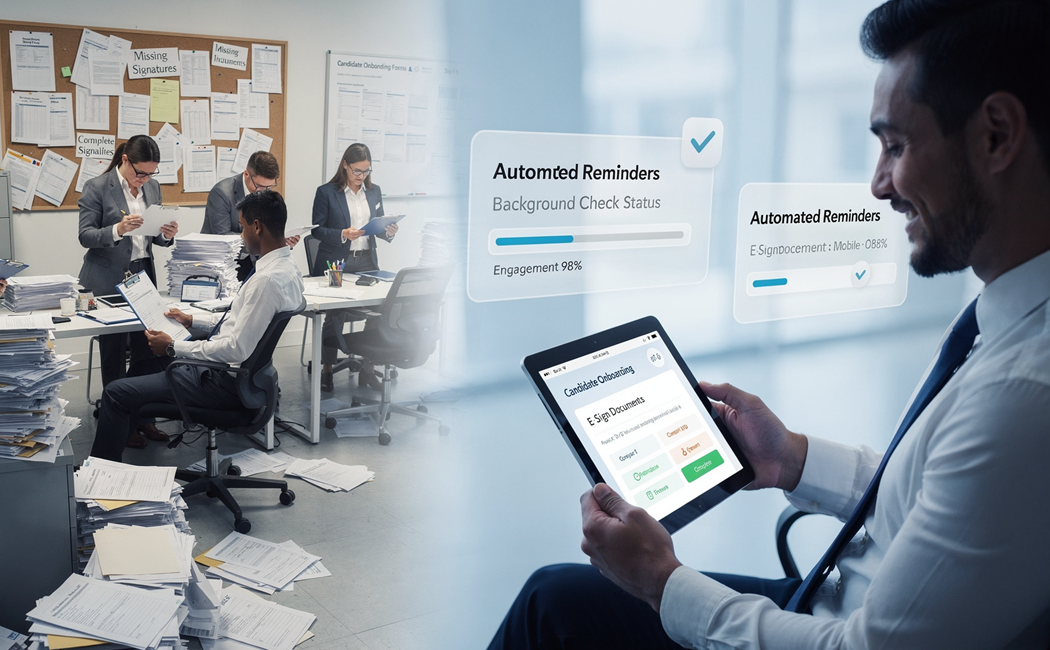
High-Volume Onboarding Best Practices for Staffing Agencies
Updated
High-volume onboarding works when four things are true: the right documents are chosen by rule for each candidate, the forms are easy to finish on a phone, compliance checks run in the background, and everyone can see one clear ready-to-work status. Get those right and candidates move from offer accepted to first shift quickly, without gaps that surface later in an audit.
Most staffing leaders name sourcing as their biggest challenge, but a lot of friction starts after the offer. That is where eligibility is confirmed, screenings are completed and documents are signed, and it is where candidates drop out if the process is slow or awkward. This guide covers what complete onboarding means, the bottlenecks that slow it down and the practices that let an agency onboard at scale.
Key takeaways
- Build packets by rule, not by hand. Location, role, client and classification should decide which documents a candidate receives.
- Design for the phone. Many hourly candidates complete onboarding between shifts on a mobile device.
- Run compliance in the background. Screenings, eligibility checks and license verification triggered automatically at the right step.
- Make ready to work a status, not a guess. One status in one system that scheduling, payroll and recruiters all trust.
What does complete onboarding mean?
Three conditions must be true before anyone is assigned.
- The paperwork is complete. Agreements, policies and client-specific forms are signed.
- Verification is done. IDs, licenses, certifications and work eligibility are collected, checked and stored in an audit-ready format.
- The status is clear. The candidate is marked ready to work in a system that payroll, recruiters and operations all rely on.
Anything less creates gaps: Crew Members starting before they are cleared, clients exposed to risk and teams scrambling when an audit arrives.
Why is temporary staffing onboarding so complex?
Because every candidate follows a slightly different path. Three things decide which path:
| Factor | What changes |
|---|---|
| Location | Required forms, notices, disclosures and retention rules |
| Role and industry | Credentials and safety requirements in healthcare, light industrial, events, hospitality and education |
| Classification | Which agreements, tax forms and client rules apply to the engagement type |
When those decisions live in someone's head or a spreadsheet, they work in a quiet week and break in a busy one.
What slows high-volume onboarding down?
Five bottlenecks account for most of the delay.
-
1
Building the right packet
Sending everyone the same packet either misses required forms or overwhelms candidates with ones they do not need. Building packets by hand slows recruiters and makes it hard to prove the right version was used.
-
2
A poor mobile experience
A process that works on a laptop but needs zooming and pinching on a phone loses candidates. Onboarding has to work on any device.
-
3
Long, flat PDFs
Dozens of fields with no guidance, no progress indicator and no check for what was missed. Candidates stall and give up.
-
4
Chasing what is incomplete
Missing signatures, half-uploaded IDs and unreadable photos block the pipeline silently. Manual follow-up turns recruiters into chasers.
-
5
No clear ready-to-work status
When readiness lives in side spreadsheets and direct messages, no one is quite sure who can be scheduled.
How do you design onboarding candidates actually finish?
Make it short, mobile and self-explanatory. Effective onboarding should:
- Use responsive forms instead of static PDFs, so fields, signatures and uploads work on any screen.
- Minimize typing with prefilled data, dropdowns and conditional questions, so candidates never enter the same information twice.
- Show progress, so candidates always know how many steps are left.
- Follow up automatically when something is missing, with a link straight back to the step.
For more on keeping candidates from abandoning the process, see how to reduce candidate drop-offs.
How do you keep compliance running in the background?
Tie each check to a step in the workflow so it starts automatically, and let recruiters see the result without leaving the candidate's record. A well-built onboarding platform handles:
- Background checks ordered for the specific role and client, with status visible on the profile.
- Work-eligibility verification where the law or the client agreement requires it, with results returned to the record and timestamped.
- License and certification checks for regulated roles; for nurses, the Nursys integration returns license status directly.
- Role-specific training and assessments completed inside onboarding, with results written back to the profile.
- Tax-credit eligibility questions, where they apply, answered during onboarding rather than on a separate form.
- Document retention rules that keep what you must keep and avoid storing what you should not.
Why e-signature alone is not enough
A generic e-signature tool digitizes signatures, but it starts from the document, not the candidate. Someone still has to decide which documents to send, the same details get typed into every form, and the data is hard to get back out for reporting or payroll. High-volume onboarding needs rules driven by the candidate's profile: location, role, client and classification.
How do you manage onboarding at scale?
Standardize the flows, automate the follow-ups, measure each step and keep one source of truth.
| Practice | What it means |
|---|---|
| Standardize flows | Consistent steps by vertical, client tier and engagement type |
| Automate follow-ups | Reminders for incomplete packets, missing documents and pending screenings |
| Track completion by step | See exactly where candidates stall and fix that step |
| One source of truth | Onboarding status, documents and notes in the system that also runs scheduling, payroll and invoicing |
Bottom line: High-volume onboarding is a system, not a checklist. Choose documents by rule, make them easy to finish on a phone, run compliance in the background and publish one ready-to-work status, and onboarding becomes a growth lever instead of a bottleneck.
For healthcare roles, see how to fix credentialing.
See onboarding a candidate can finish on a phone
Watch a packet build itself from location and role, a candidate complete it on a phone and the ready-to-work status update, in a live demonstration.
Book a demo