
On-Demand Staffing in 2026: Which Verticals Actually Fit
Updated
On-demand staffing is technology-run shift work: clients request cover, Crew Members accept it on a phone, and scheduling, compliance and time capture happen in the platform rather than over email. It is growing in 2026, but not because the staffing market is growing. The market is close to flat, and the share moving into short, shift-based engagements is growing inside it.
That distinction matters more than it sounds. An agency that reads "on-demand is growing" as a rising tide will wait for demand that is not coming. An agency that reads it as a change in how the same work is bought will go and take share from agencies still running shifts on spreadsheets and phone calls. This post covers which verticals genuinely fit the model, what a platform has to handle in each, and what to do about it.
Key takeaways
- The market is not booming. The US staffing market is forecast to grow 0.8% in 2026 after falling 2.8% in 2025, and staffing sales in the first quarter were down 1.6% year over year.
- The mix is shifting anyway. Of more than 300 industries the BLS tracks, temporary help services added the second-highest number of jobs in 2026, and roughly one in ten jobs created this year was a temporary position.
- Fit is about demand shape, not sector. A vertical suits shift-based staffing when demand swings unpredictably, the work splits cleanly into shifts, requirements are explicit, and compliance can be automated.
- Pick one or two verticals, not six. Depth in a vertical is what produces repeatable sourcing, credentialing and client expectations. Breadth produces six shallow playbooks and no advantage in any of them.
- The constraint is operational, not commercial. Same-day fill is a throughput problem. Agencies that win these accounts have made credentialing, dispatch and time capture fast enough to serve them profitably.
What is on-demand staffing, and how does it differ from temp staffing?
On-demand staffing is shift-based staffing run through software instead of through a coordinator's inbox: clients request cover, the request reaches qualified Crew Members immediately, and acceptance, credential checks and clock-in all happen in the platform. It is not a different kind of work from temp staffing. It is the same work with the waiting removed.
| Step | Traditional temp staffing | On-demand staffing |
|---|---|---|
| Request | Phone call or email to a coordinator, in office hours | Client raises it in a portal, at any hour |
| Matching | Recruiter works a list and rings people individually | Qualified Crew Members see the shift and accept it |
| Compliance | Checked manually, often after the placement | Eligibility enforced before the shift is offered |
| Time capture | Paper or recalled hours, reconciled later | Clock-in on a phone, with location evidence attached |
| Client visibility | Ask the branch | Sees who accepted and who is on site, live |
Everything in the right-hand column is one capability: the agency can act without a person in the middle. That is what makes same-day cover profitable rather than merely possible, and it is why on-demand staffing software is the constraint on this model rather than the demand for it.
Is on-demand staffing actually growing in 2026?
Yes, but as a shift in how work is bought rather than as growth in the staffing market overall. The two get blurred constantly, and they lead to opposite decisions.
The market itself is roughly flat. Staffing Industry Analysts forecast the US staffing market to grow 0.8% in 2026, after a 2.8% decline across the Americas in 2025. The American Staffing Association reported first-quarter 2026 staffing sales of 27.6 billion dollars, down 1.6% year over year, with staffing employment down 4.6% — described as the slowest first-quarter rate of decline since 2022. Stabilizing, not surging.
Underneath that, the composition is moving. The ASA's chief economist reported in August that of more than 300 industries the Bureau of Labor Statistics analyzes, temporary help services added the second-highest number of jobs in 2026, and that around one in ten jobs created this year was a temporary position. He also noted that 40% of temporary workers in 2025 were aged 18 to 29 — the people least attached to a fixed schedule and most comfortable accepting work in an app.
Watch out
Reading this as a demand boom is the expensive mistake. Total spend is not rising much, so growth in shift-based work has to come from somewhere — and mostly it comes from agencies that cannot fill same-day losing those accounts to agencies that can. It is a share fight, and the weapon is throughput.
Which industries actually fit on-demand staffing?
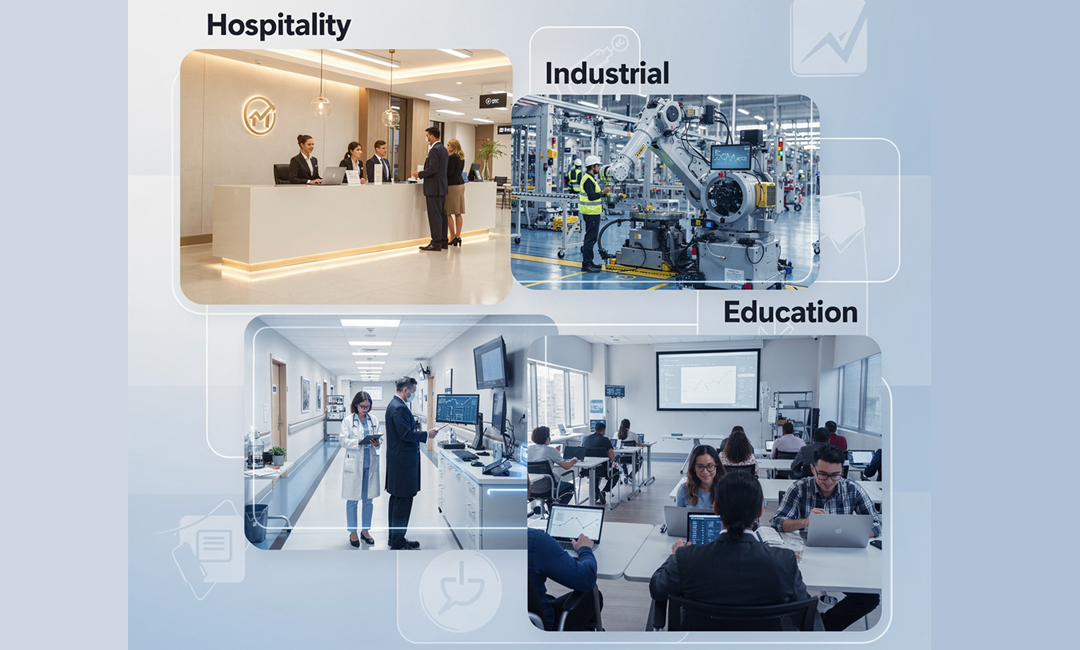
The verticals that fit are the ones where demand swings without warning and an unfilled shift costs the client the same day. The sector label matters less than the shape of the demand, which is why the list below holds together despite spanning classrooms, hospital units and warehouse floors.
| Vertical | What drives the swings | What the platform must handle |
|---|---|---|
| Education | Same-day absences across many sites | Credential tracking, background screening, site-based matching |
| Healthcare | Patient census, acuity, sudden absence | License and certification status, unit-skill matching, shift differentials |
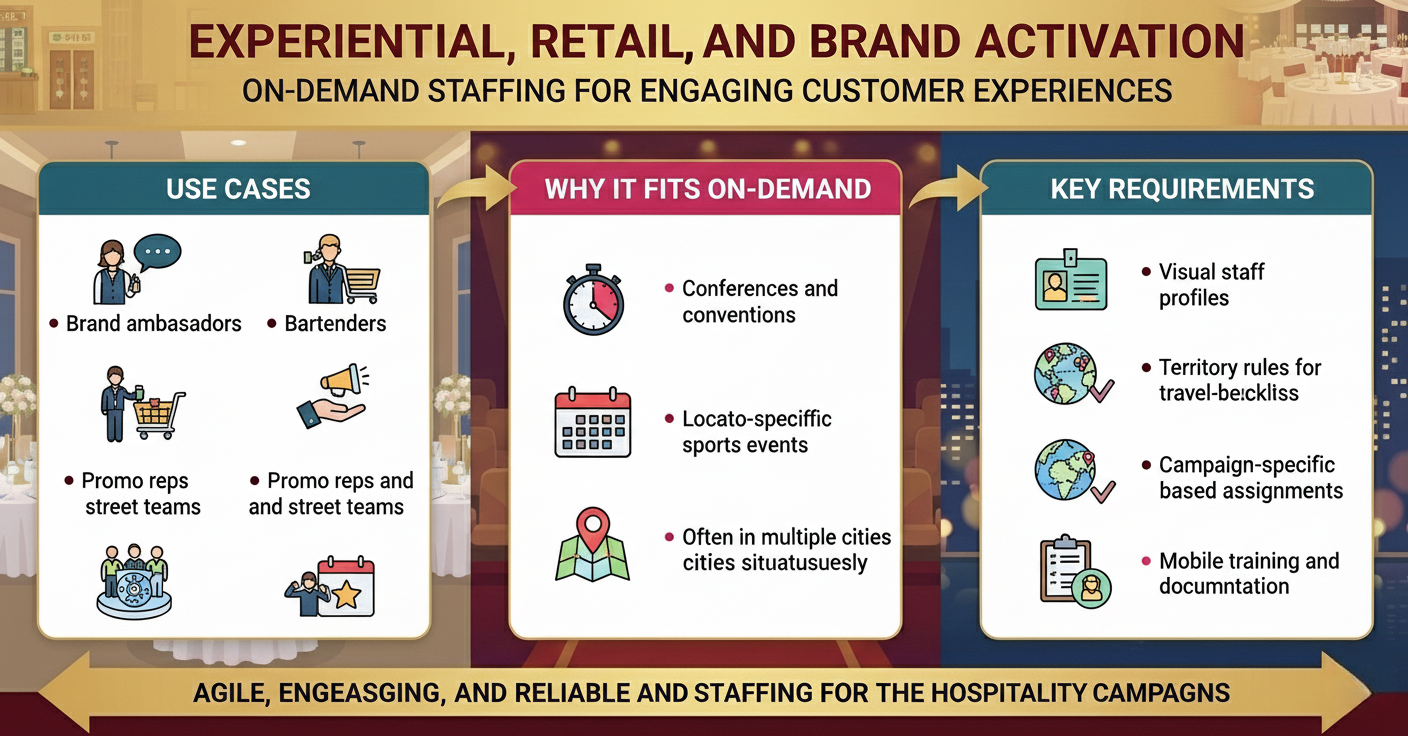
| Hospitality and events | Conferences, weddings, seasonal peaks | Bulk shift posting, location-based clock-in, fast onboarding |
| Experiential and retail | Campaign dates across multiple cities | Territory rules, campaign checklists, mobile briefing materials |
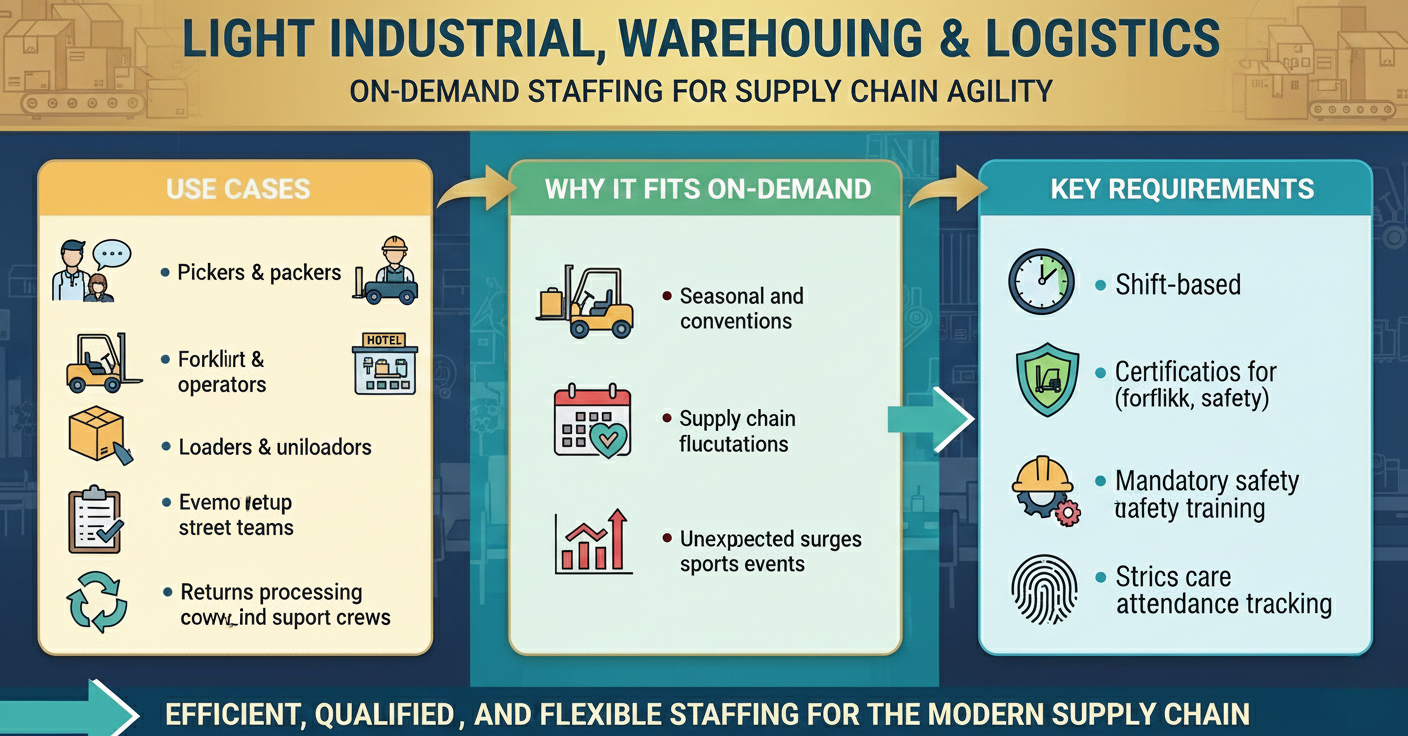
| Light industrial | Order surges and supply-chain swings | Equipment certifications, safety training records, attendance tracking |
| Corporate support | Short projects and cover gaps | Skills tagging, on-site or remote flags, client self-service requests |
Education: substitute and support staff
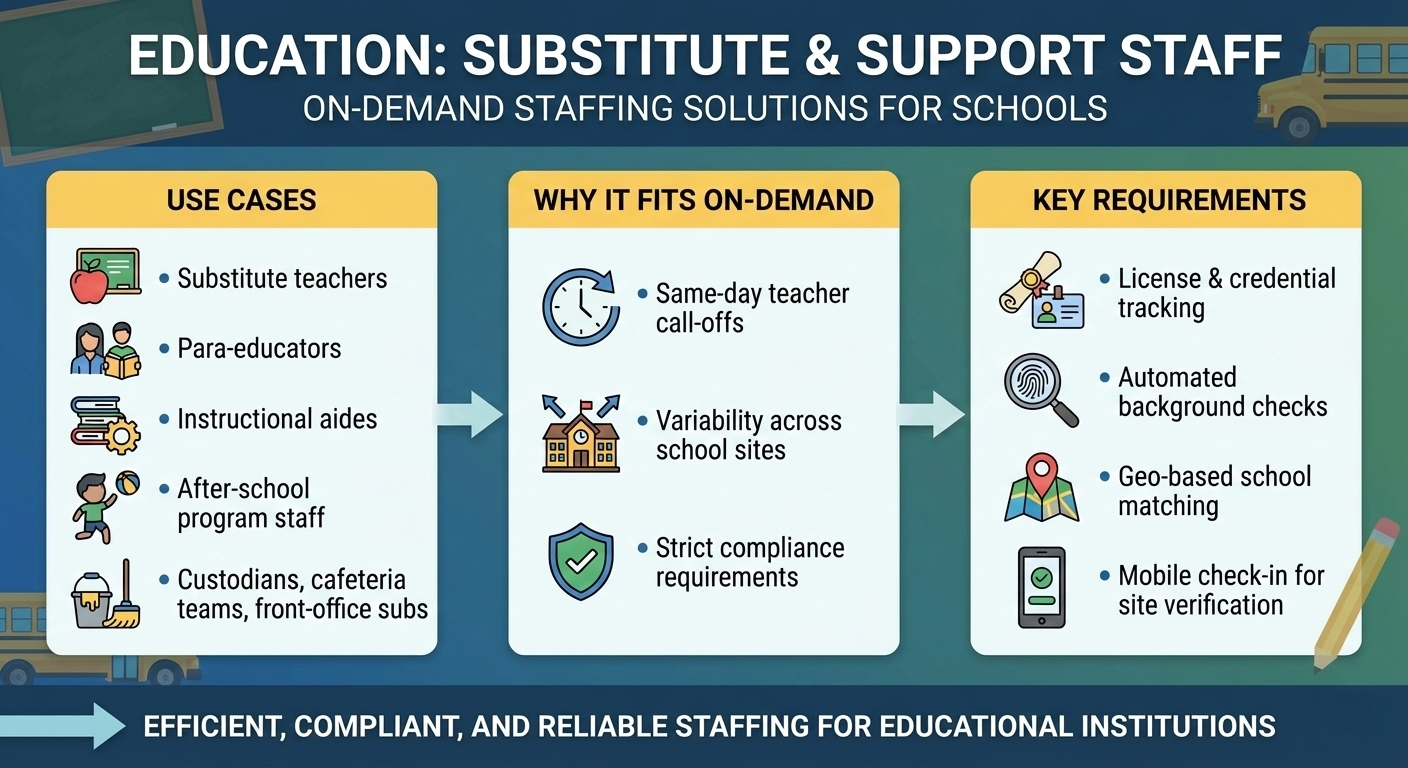
Substitute teachers, para-educators, instructional aides, after-school staff, and cafeteria and front-office cover. Districts learn about most absences hours before the bell, across sites that are not interchangeable, under screening rules that leave no room for a judgment call. Everything about that favors a system that knows who is cleared for which site and can reach them at once.
Healthcare: PRN and per diem
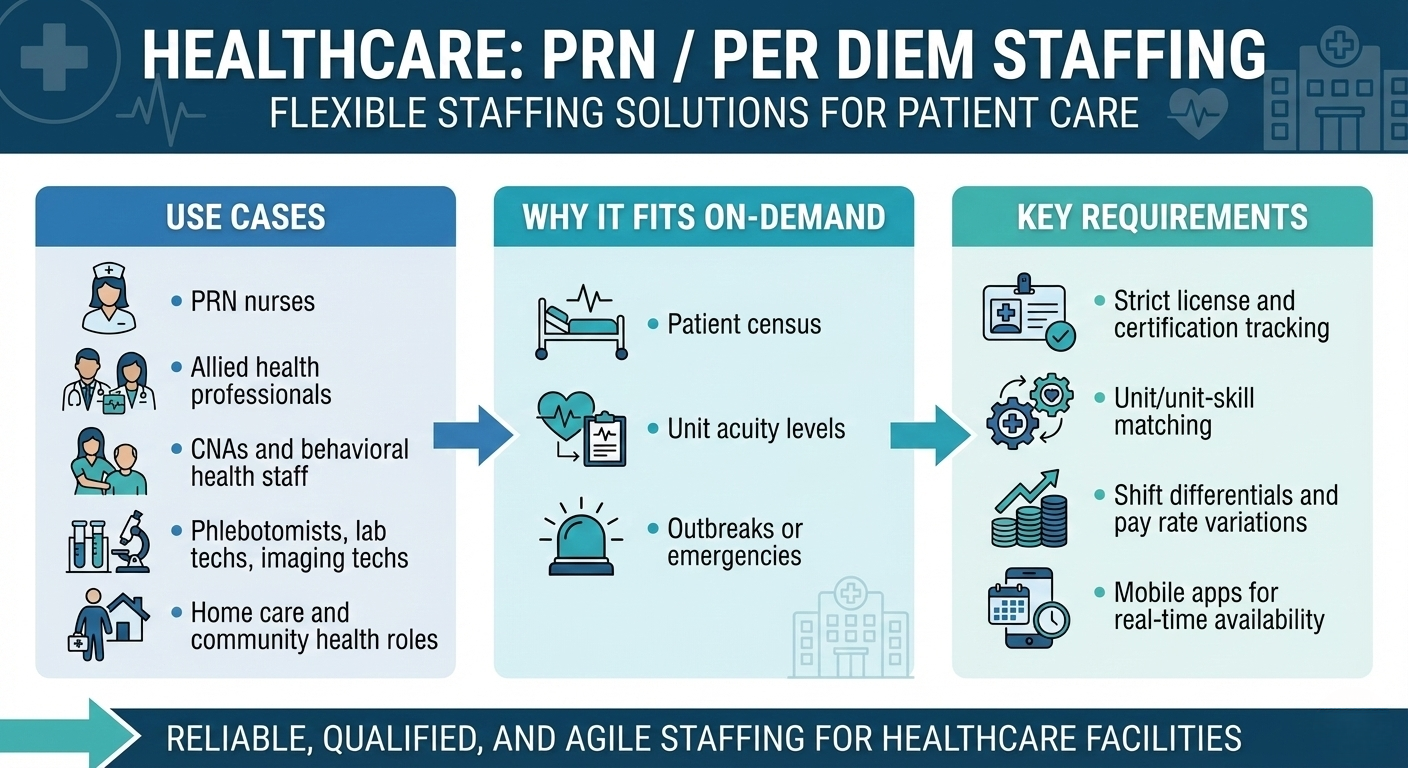
PRN nursing, allied health, CNAs, behavioral health, phlebotomy, lab and imaging, and community health roles. Demand moves with patient census and unit acuity, so gaps appear within a shift rather than a quarter. This is the least forgiving vertical on compliance and the most valuable to get right, which is why per diem staffing is where most agencies feel the limits of their own systems first.
Hospitality and events
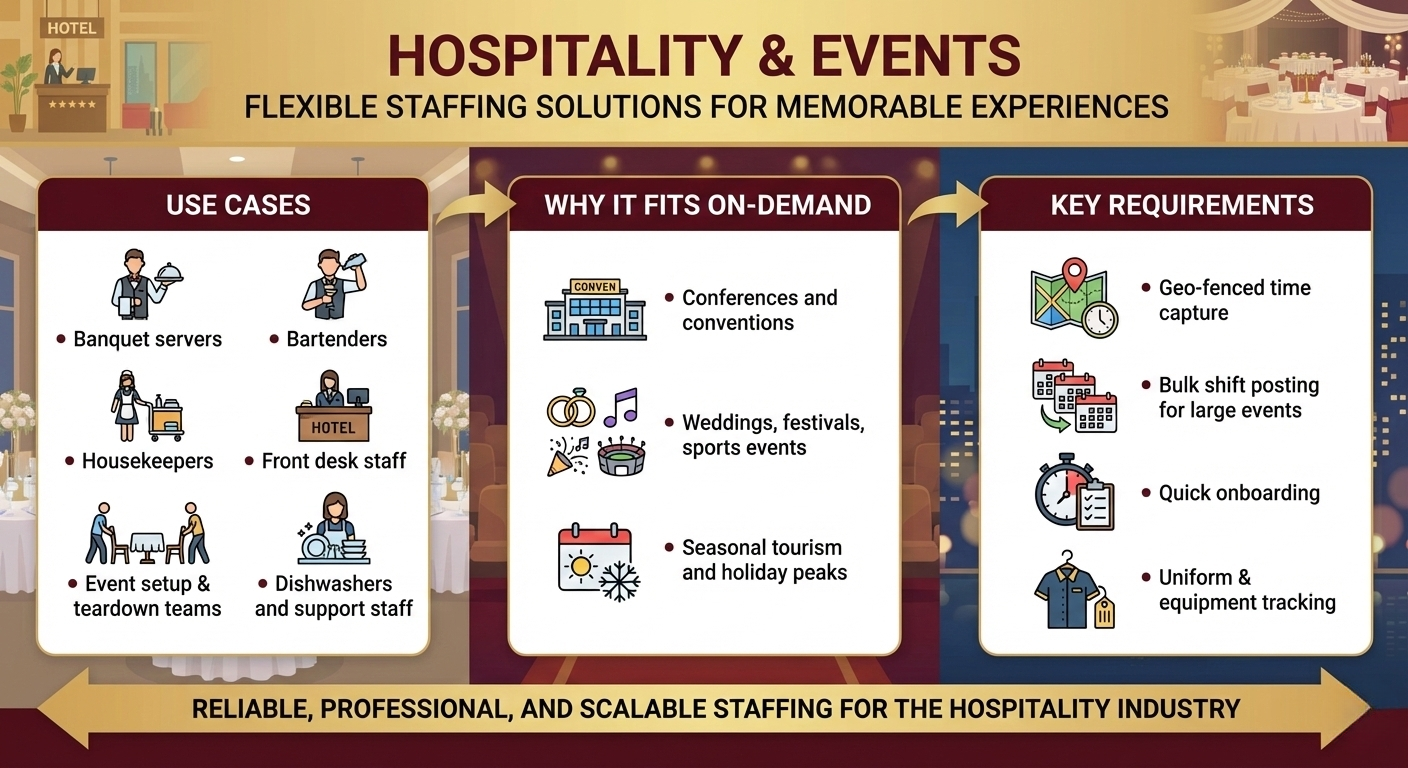
Banquet servers, bartenders, housekeepers, front-desk cover, and setup and teardown crews. Headcount for a single weekend can be several times a normal week, and the order often arrives as one line: forty people, Saturday, this venue. Bulk posting and location-verified clock-in carry most of the weight here.
Experiential, retail and brand activation
Brand ambassadors, in-store demonstrators, sampling teams and event marketing crews. Assignments are short, tied to a campaign date, and frequently running in several cities at once, so the agency is coordinating a calendar rather than filling a vacancy. Territory rules and briefing material delivered to a phone are what make it work at scale.
Light industrial, warehousing and logistics
Pickers and packers, forklift operators, loaders, inventory teams and returns crews. Sites run around the clock and volume moves with promotions and supply-chain disruption, so the useful capability is adding a shift's worth of cleared, certified people at short notice without loosening the safety requirements.
Corporate and office support
Reception cover, event check-in, short admin projects, data clean-up and holiday-season support. The work is sporadic rather than seasonal, and the client's alternative is carrying headcount they only need occasionally. This is the segment where client self-service does the most work, because the requests are small, frequent and rarely worth a phone call.
What makes a vertical a good on-demand fit?
Four conditions separate a vertical that suits shift-based staffing from one that only looks like it does. If a prospect's work fails two of them, the model will cost you more than it returns.
- Demand swings unpredictably. Not merely seasonally. Seasonal peaks can be planned for; same-day gaps cannot.
- The work splits into shifts. A role that needs two weeks of context before it is useful is not a shift, whatever the client calls it.
- Requirements are explicit. Role, certification, site and shift window stated up front, so eligibility can be decided by a rule rather than a conversation.
- Compliance can be automated. Credentials that are checkable and datable. Where eligibility needs human judgment on every assignment, throughput collapses.
How should an agency position for this?
Treat it as an operations program, not a marketing one: the agencies taking these accounts have made same-day fill cheap enough to be profitable. Five moves, in the order they pay off.
-
1
Pick one or two verticals and go deep
Build the sourcing, credentialing and client expectations for one vertical until they are repeatable, then copy the playbook to the next region rather than the next sector. Six shallow verticals produce no advantage in any of them.
-
2
Get the pool onto a phone
Crew Members browsing and accepting shifts, uploading credentials and clocking in from their own app is the difference between a recruiter ringing a list and a shift filling itself. Location-verified clock-in also settles most hour disputes before they start.
-
3
Make compliance a gate, not a report
Licenses, certifications and training tracked in one place, with expiry visible across the pool and lapses flagged well ahead. Checked before a shift is offered, compliance speeds dispatch up instead of slowing it down.
-
4
Let clients raise and approve their own work
Shift requests, live visibility of who is on site, and hour approval without an email chain. It removes the administrative traffic around the account manager rather than the account manager.
-
5
Connect the systems you already run
Staffing automation earns its keep when scheduling, payroll and messaging share one record, so confirmations, reminders and timesheet nudges go out without anyone sending them. Predictive matching is worth having only once that plumbing exists.
Bottom line: On-demand staffing for staffing agencies is not a wave to ride in 2026, it is a change in who wins the same work. The accounts move to whoever can fill a shift today without a scramble, and that is decided by your credentialing, dispatch and time capture rather than by your pitch.
If the model fits your accounts, the two decisions that follow are which verticals to commit to and whether the shift experience carries your brand or someone else's. A client self-service marketplace covers the first, and white label staffing software covers the second. Agencies concentrating on a single vertical can start from the healthcare, hospitality or industrial build.
See how fast your shifts could actually fill
NextCrew runs shift requests, credential-gated dispatch, mobile acceptance and time capture in one system, under your brand. Walk through it with a live demonstration against your own order flow.
Book a demoFrequently asked questions
Source: Staffing Industry Analysts, "Americas staffing market to grow 1.1% this year", 28 May 2026 — US market forecast 0.8% growth in 2026 following a 2.8% Americas decline in 2025.
Source: American Staffing Association, "U.S. Staffing Industry's Seasonal Declines Narrow in First Quarter of 2026", 25 June 2026 — first-quarter staffing sales of 27.6 billion dollars, down 1.6% year over year; staffing employment down 4.6% year over year.
Source: Noah Yosif, Chief Economist, American Staffing Association, writing in Fortune, 24 August 2026 — temporary help services second-highest job gains of more than 300 BLS industries in 2026; roughly one in ten jobs created in 2026 temporary; 40% of temporary workers in 2025 aged 18 to 29. Figures are United States.