
How Healthcare Staffing Agencies Build a Float Pool That Wins More Business
Updated
Float pool management is how a healthcare staffing agency turns a list of per diem nurses and clinicians into coverage a facility can count on. The agencies that win the first call do four things well: they build pool depth before it is needed, broadcast open shifts to everyone qualified at once, check credentials at the moment of scheduling, and track fill rate as a named number.
Most agencies already have the people. What breaks down is the system for reaching them fast enough, with the right credentials confirmed, before the facility gives the shift to someone else. This guide covers what a working healthcare float pool looks like, the four layers that run it, and what changes when those layers are connected.
Key takeaways
- The pool is a client retention asset. Facilities remember who filled the shift at short notice. A reliable float pool is what makes your agency the first call rather than the fallback.
- Sequential phone calls are the main bottleneck. Calling a roster one name at a time burns the shift window. Broadcasting to every qualified Crew Member at once is the single biggest improvement most agencies can make.
- Credentials belong at the point of scheduling. When coordinators cannot see credential status quickly, they keep sending the same few people, who burn out.
- Measure it. Fill rate, same-day coverage and response time should be tracked by facility, not estimated.
Why is a float pool a client retention asset?
Because in healthcare staffing the facility judges you on the shift you filled at short notice, not on the ones that were planned weeks ahead. A charge nurse with an open shift at 6 a.m. calls the agency that answered last time. Fill it fast and fill it with the right clinician, and you become the default. Miss it, and the facility quietly moves you down the list. That is why float pool management sits closer to account management than to back-office operations: it is where client relationships are kept or lost, one shift at a time.
What does a typical agency float pool look like today?
Usually a strong team working inside fragile infrastructure. The pattern is similar at agencies of every size:
- Sequential outreach. Coordinators call down a roster until someone says yes. By the fourth call the shift window has narrowed and the facility has noticed.
- Credential data nobody fully trusts. Status lives in a spreadsheet, so schedulers default to the Crew Members they already know are cleared.
- The same core group gets every shift. They burn out or leave, and the rest of the pool goes cold.
- Call-offs handled by hand. When a clinician cannot make it, the scramble starts from zero, and the facility often hears about the gap before a replacement is confirmed.
- No number. There is a feeling that filling shifts is getting harder, but no fill rate by facility to prove it or fix it.
If that sounds familiar, the problem is not your people. It is the system your coordinators are working inside.
What are the four layers of a healthcare float pool?
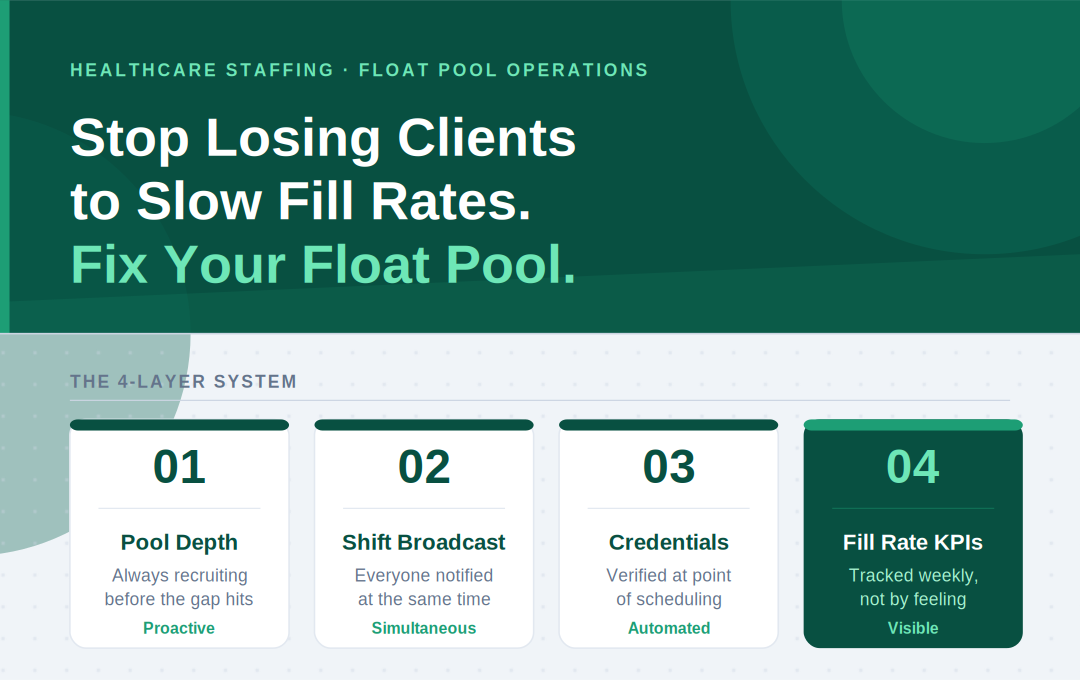
Pool depth, shift broadcasting, credential visibility and fill rate tracking. Each one has a direct line to fill rate. Fix the weakest first.
-
1
Pool depth: build before you need it
Keep recruiting, onboarding and credentialing open all year so the per diem nurse pool grows steadily rather than in bursts after a crisis. Pre-match Crew Members to the facilities and units they are cleared for, so they are ready before the request arrives. See how to run onboarding at volume for the intake side.
-
2
Shift broadcasting: reach everyone qualified at once
Send each open shift to every qualified, available Crew Member at the same time through float pool scheduling software, and let them claim it from their phone. Response time moves from hours toward minutes because the people who would take the shift actually see it in time.
-
3
Credential visibility: at the moment of scheduling
Show licenses, certifications and facility clearances next to each name when the coordinator assigns the shift. A good system keeps every expiry visible across the pool and flags what is lapsing well ahead, so the coordinator can assign someone new with confidence instead of falling back on the familiar few.
-
4
Fill rate tracking: a named KPI
Track fill rate, same-day coverage and time to fill by facility and shift type. When these numbers are visible, you can see which facility is slipping before its manager tells you.
What changes when the four layers are connected?
The handoffs stop depending on a person remembering to make them. A facility posts a shift request, or your coordinator enters it. The shift goes out to every Crew Member cleared for that unit. Someone claims it from the mobile app. The coordinator sees credential status beside the name and confirms. After the shift, hours flow through timesheet management into payroll and invoicing without being typed again. The coordinator's day shifts from chasing people to handling exceptions.
| Layer | Run manually | Run as a connected system |
|---|---|---|
| Pool depth | Recruiting starts after a gap appears | Onboarding stays open; Crew Members are pre-matched to facilities |
| Shift broadcasting | One phone call at a time | Every qualified Crew Member notified at once |
| Credentials | Checked after the assignment, if at all | Visible beside each name when scheduling; lapsing items flagged early |
| Fill rate | A feeling | Tracked by facility, unit and shift type |
Watch out
Be careful with fill rate benchmarks. Published averages vary by specialty, region, shift type and how each agency defines a fill, so a single industry number rarely tells you much. Your own fill rate by facility, tracked month over month, is the number that matters, and it is the one a facility manager will ask about.
What objections come up, and how do you answer them?
"Our Crew Members don't respond to broadcasts."
Low response is usually a format and timing problem. A shift offer that arrives as an app notification with enough lead time gets seen; a voicemail left after three other calls does not. Broadcasting fixes the sequencing problem, which is the root cause. If response is still low, look at how far ahead shifts go out and whether the offer shows everything the clinician needs to decide: unit, times, rate and location.
"Our pool is too small to make a difference."
A smaller pool that is kept current and can be reached in one step will outperform a larger one managed through a phone list. Depth comes from keeping onboarding permanently open, not from a one-off recruiting drive. Start by broadcasting to the pool you have and measuring how quickly shifts are claimed.
Bottom line: A float pool wins business when it is deep before demand arrives, reachable in one step, credential-visible at the moment of scheduling and measured by facility. None of that needs a bigger pool. It needs a managed one.
For the wider picture, see where per diem nurse staffing is heading and how to prevent and track no-shows, which covers what to do when a confirmed clinician does not arrive. NextCrew's healthcare staffing software connects float pool availability, scheduling, credential tracking and timesheets in one system.
See a float pool run end to end
Watch an open shift go from request to claimed, credential-checked and on the timesheet in a live demonstration built around your own facilities.
Book a demo