
Why Staffing Agencies Stop Growing, and the Four-Function System That Fixes It
Updated
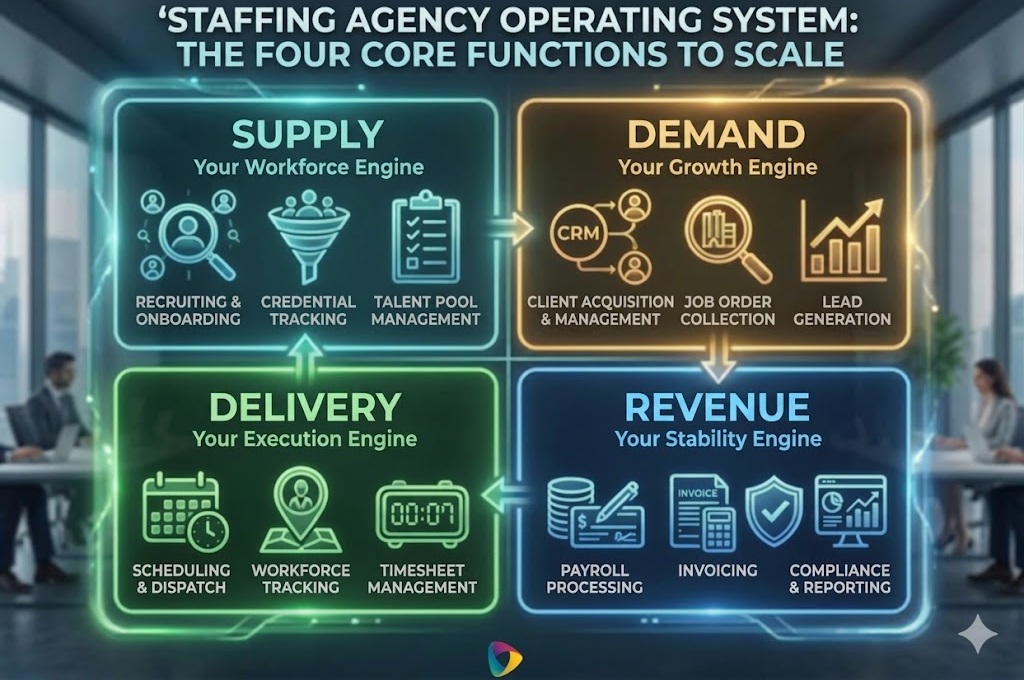
Most staffing agencies do not stall because demand dries up. They stall because four core functions (Supply, Demand, Delivery and Revenue) run as separate efforts instead of one system. Find the function creating the most drag, fix it first and connect it to the others, and growth stops depending on longer hours.
Most agency owners can tell you exactly what went wrong last week. A client called about a no-show. A Crew Member was paid late. A new order came in, but the bench was thin. These problems feel random, but they are not. Almost every problem in staffing agency operations traces back to one of four functions. We call the way those functions fit together the staffing agency operating system: a practical framework for finding what is slowing growth.
Key takeaways
- Structure matters more than talent. Strong teams still struggle inside a structure that makes every order a scramble.
- Four functions, four failure points. Supply, Demand, Delivery and Revenue each break in a predictable way.
- Problems travel downstream. A Delivery gap becomes a Revenue error; a Supply gap becomes a Demand you cannot fulfill.
- Fix one function at a time. Start with the one causing the most recurring problems, then connect it to the rest.
Why does structure matter more than talent?
Because without a system, growth creates complexity rather than efficiency. Many owners believe growth comes from better recruiters or a stronger sales team. Talent matters, but staffing agency growth comes from structure: agencies that scale well do not just hire more people. They improve how supply, demand, delivery and revenue work together. Without that, even strong teams keep meeting the same problems: missed shifts, late payroll, inconsistent service.
What does a typical staffing agency look like?
Map real operations and the same patterns appear in each function.
| Function | What it typically looks like |
|---|---|
| Supply | Recruiting starts only when orders arrive; onboarding is manual; credentials are scattered across spreadsheets |
| Demand | Revenue depends on a few key clients; new business is inconsistent; little visibility into upcoming needs |
| Delivery | Scheduling runs on calls and spreadsheets; no-shows trigger last-minute scrambles |
| Revenue | Payroll delays, invoicing gaps and slow reporting; data errors cascade from upstream |
If this sounds familiar, you are not running a broken agency. You are running a typical one. The question is whether this model can support the growth you want.
Free self-assessment
Score your agency across all four functions
The Staffing Agency OS Audit is 16 questions, four per function. You score each answer from 1 to 5, and the scoring guide shows which function is your weakest link and what to fix first. It takes about 10 minutes and gives you a diagnostic you can share with your leadership team.
What are the four functions of a staffing agency?
The four core functions are Supply, Demand, Delivery and Revenue. Each has a clear job and a predictable failure point.
-
1
Supply: your workforce engine
A structured recruiting pipeline with several active sources, onboarding finished before the first shift, credentials tracked automatically and a talent pool you can search by skill, certification, location and availability. Agencies that struggle here recruit only when they urgently need people.
-
2
Demand: your growth engine
Every client relationship and open order tracked in a staffing CRM, clients able to submit orders without calling your desk, and a business development pipeline that does not rely only on referrals. Without it, one client pausing can create a cash flow problem overnight.
-
3
Delivery: your execution engine
Shifts dispatched and confirmed ahead of time, clock-in captured on the Crew app, timesheets reviewed promptly and no-shows flagged with a coverage workflow already under way. This is the function clients see most, and the one that decides whether they renew.
-
4
Revenue: your margin engine
Payroll closes on time because timesheet data feeds it cleanly, invoices go out soon after each completed shift, and margin and fill rate reporting is available without anyone building a spreadsheet. This is where completed work becomes collected, profitable revenue, or where slow leaks erode margin.
What happens when the functions are not connected?
Each function's problem amplifies the next. Supply gaps mean Demand cannot be fulfilled. Delivery gets overwhelmed as coordinators patch scheduling holes. Revenue suffers because timesheet and shift data arrives late or incomplete. Agencies that try to fix this by adding headcount find the operational load grows faster than the revenue.
What changes when the system works?
Each function feeds the next automatically.
- Supply feeds Demand with live availability, so sales and account managers know what capacity exists before committing.
- Demand triggers Delivery, so a new order starts scheduling, communication and confirmation without a manual handoff.
- Delivery feeds Revenue with accurate timesheets and shift records that flow into payroll and invoicing.
- Revenue closes the loop with reporting that shows patterns across all four functions.
NextCrew is built to connect all four functions, from a Crew Member's first application to the client's invoice, but the pattern applies to any staffing technology stack. What matters is that the engines talk to each other. For how to assemble one, see building the right tech stack for a staffing agency.
What do agencies commonly get wrong about operations?
"Structure is for large agencies."
Structure is for agencies that want to grow. Smaller agencies benefit most from putting systems in place early, before the manual workload compounds. Digital onboarding, for example, is far easier to set up at 50 placements a week than at 500.
"We already have software."
The question is whether your software connects all four functions or just one. An onboarding tool that does not link to scheduling leaves a manual handoff between Supply and Delivery. A CRM that does not connect to Delivery means account managers still call coordinators to check capacity. Coverage matters, but so does connection.
Bottom line: The difference between agencies that scale and those that plateau is not effort. It is structure. Find the function that is breaking down, fix it, and connect it to the other three.
For what each role gains when the functions are connected, see how automation helps every role inside a staffing agency. For the most common Delivery failure, read how to prevent and track no-shows.
See all four functions connected
Walk through an order from Supply to Revenue in NextCrew, using your own workflow, in a live demonstration.
Book a demo